Several small teams are attempting difficult climbs on Nepal’s 6,000 and 7,000m peaks. Unfortunately, they rarely report on their plans or progress until they return, and often only if they succeed.
This is what we know about the ongoing expeditions:
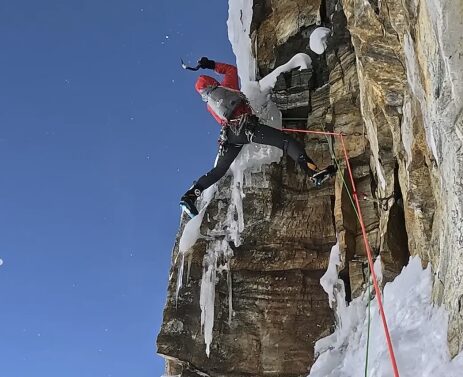
Three young French climbers, members of the Military High Mountain Group from Chamonix, celebrated their organization’s 50th anniversary with a new route on Peak 41. This 6,654m mountain is located in the Khumbu region and is often called the “true Mera Peak.”
Konrad Piontek, Amaury Fouillade, and Clovis Paulin took advantage of a good weather window and achieved the first ascent of the peak’s northeast face. They climbed in an alpine-style single push over four days. The result is a beautiful 1,400m line with difficulties up to ED+ 5+ M6 A1 90°. They descended via the southeast face. The team named their line Bon Matin (good morning).
Jugal II
Nivel Meroi and Romano Benet are acclimatized and ready to attempt a new route on Jugal II, but the Italian couple will be on their own. Tine Cuder of Slovenia, the third team member, has left due to illness.
Jannu
Meanwhile, in the Kangchenjunga region, a large Russian team has also finished acclimatizing. The team trekked in the area and crossed a number of high-altitude passes, the latest of them at the top of an icefall at 5,750m. They reported lots of snow above 5,000m but are ready to attempt a new route on the formidable Jannu (7,710m) from its southeast side.
The team comprises Ivan Artemov, Ivan Volkov, Artem Zhdanov, Konstantin Neumoin, Roman Shilin, and Vasily Yagodin.
Gangapurna West
Hidesuke Taneishi and Tetsu Hashimoto of Japan traveled to Nepal in September, aiming to achieve the first ascent of Gangapurna West (7,455m), also known as Asapurna or Peak Lachenal. They have provided no news since, but they probably had to retreat when an intense snowstorm hit the Annapurna region three weeks ago.
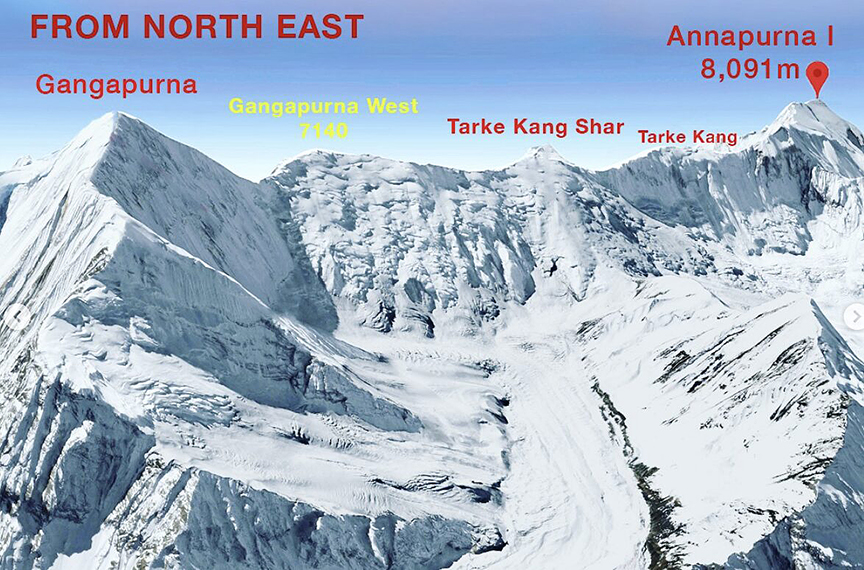
Location of Gangapurna West on a Google Earth screenshot. Notes by Lindsay Griffin for the American Alpine Journal.
Meanwhile, a second team has reached the base of the peak with the same objective. Valery Shamalo, Natalia Zanina, Maksim Trufanov, and Ruslan Kirichenko arrived at the beginning of October and saw no one else there. They reported that recent precipitation had left the trail in a poor state; the climbers had to cross landslides and swollen rivers to reach base camp.
The team has completed two acclimatization climbs, looking for a passage through the icefall at the base of the mountain and then a series of couloirs. They reached 5,900m and, on a second trip, 6,600m. Deep snow covered the peak, which slowed progress. Finally, they launched a summit bid last week.
From 6,600m, they spent a day on technical ice sections of 70–80º. In poor visibility, they endured spindrift and were showered by small ice chunks.
“In the afternoon, the weather deteriorated sharply,” Natalia Zanina said. “Heavy snowfall began, and we started being struck by large, continuous avalanches. At 6,800m (340m from the summit), we decided to turn back.”
A note on names: according to 8000ers.com, Asapurna should be the correct name for this peak because — although it is closer to Gangapurna — Asapurna’s summit ridge connects directly to Annapurna III.
Mystery teams
The list of climbing permits granted by Nepal’s Ministry of Tourism points to some other interesting expeditions, some of them in remote western Nepal. There is a permit for Nyalu Kang (6,265m), only opened to foreign climbers in 2024 and reportedly unclimbed, and Ardang, summited once by Canadians Bryce Kendall and Sunny Twelker in 2019. Victor Saunders and Mick Fowler of the UK attempted Ardang last year.