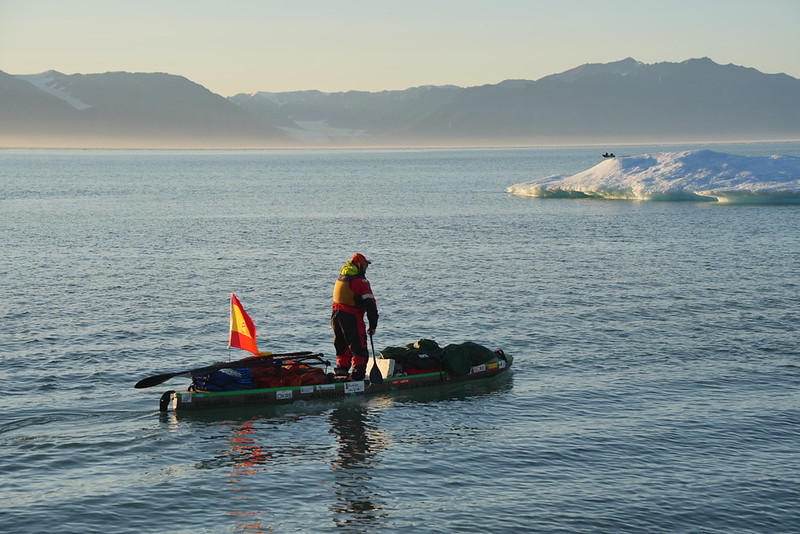
Antonio de la Rosa’s attempt to paddle the Northwest Passage began slowly when 40kph winds left him sheltering in place just a short distance from his start point at Cape Liverpool on Bylot Island.
The 57-year-old Spaniard’s attempt at a full, solo crossing of that long and difficult Arctic passage uses a unique craft. His modular two-section Sunova prototype board serves as a stand-up paddleboard, but he can also row it and drag it as a sled over ice.
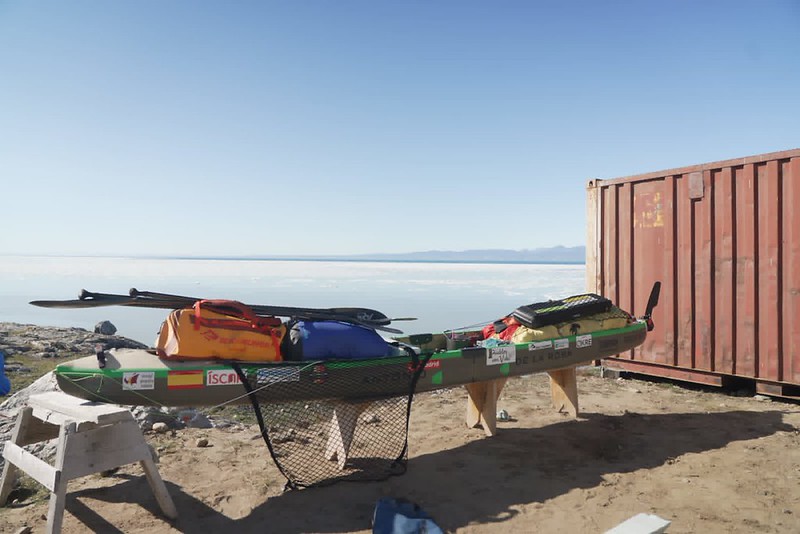
De la Rosa’s paddleboard. Photo: Antonio de la Rosa
Weather and windbound days
The success of his expedition partly relies on the movement of pack ice — the thick, broken chunks that can impede the way for vessels of all sizes. Just a couple of days before De la Rosa’s planned departure, easterly winds helped clear some of the way. But when he finally set off on July 17, any hopes of a fast start were quickly dashed by strong winds and freezing temperatures.
Those attempting the Passage must expect windbound days, but any delay requires careful management of food and fuel supplies. De la Rosa had left Pond Inlet with 35 days of food that must last him until the small town of Cambridge Bay, roughly 1,500km and halfway through his expedition.
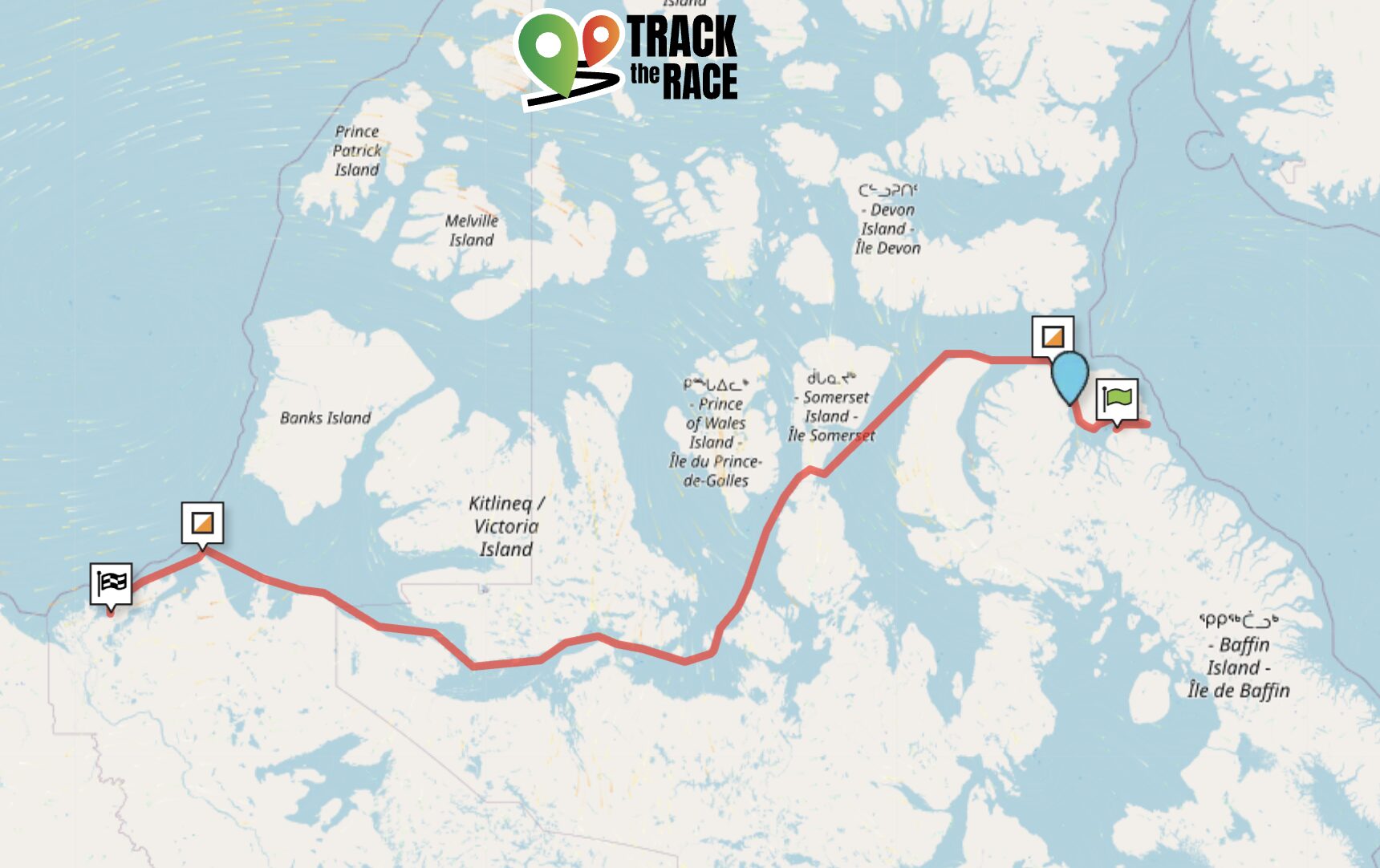
De la Rosa’s proposed route through the Northwest Passage. Green marks his start point, blue marks his current position, and the orange-and-white square marks the end of the Northwest Passage. The checkered flag beyond indicates the town of Tuktoyaktuk, where he will stop. Photo: Antonio de la Rosa/Track the Race
Conditions improved enough for De la Rosa to resume his journey on July 21. His planned route had originally tracked north, following the northern coast of Bylot Island. But after speaking to Parks Canada and the Royal Canadian Mounted Police, there was a late change of plan. Authorities told De la Rosa that the northern route would include particularly strong marine currents, while regulations in Sirmilik National Park aimed at protecting nesting birds prohibited him from landing on shore. Instead, De la Rosa is following the southern coastline through the Eclipse Sound.
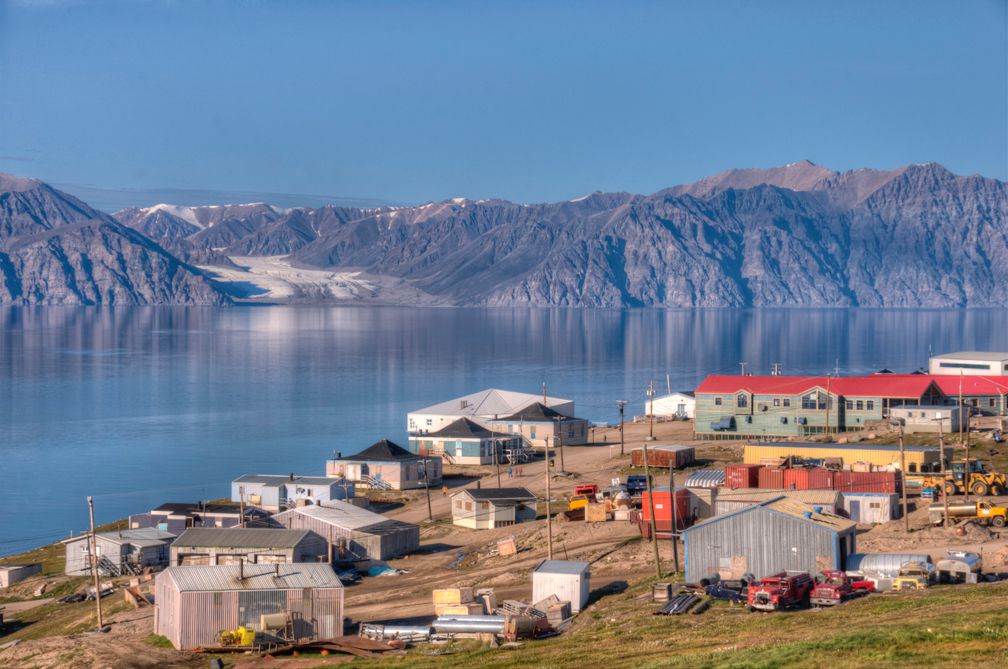
Pond Inlet, with a view across to Bylot Island. Photo: Jerry Kobalenko
A long way to go
Though the southern route is more sheltered, the rugged coastline of Bylot Island makes landings and launches tricky. On July 23, De la Rosa’s team described a hard start that resulted in some damage to the paddleboard.
“The point where Antonio spent the previous night was heavily exposed to swell, and getting the board and all his gear into the water between waves proved the toughest moment of the entire day. The launch operation, which would normally take minutes, took him close to a full hour, in intense morning cold and with a strong tailwind that added to the difficulty,” they wrote in a daily update. While struggling to escape the coastline, the board’s fin was damaged, though it remains functional for now.
De la Rosa has covered 80km in the last two days, an impressive pace. However, he has a long way to go. He estimates that the expedition will cover 3,000km, ending in the small town of Tuktoyaktuk at the western edge of the Passage. He has plenty of rowing and paddling experience with several expeditions and races under his belt, including a solo crossing of the Pacific by paddleboard in 2019, when he covered 4,750km between San Francisco and Hawaii.
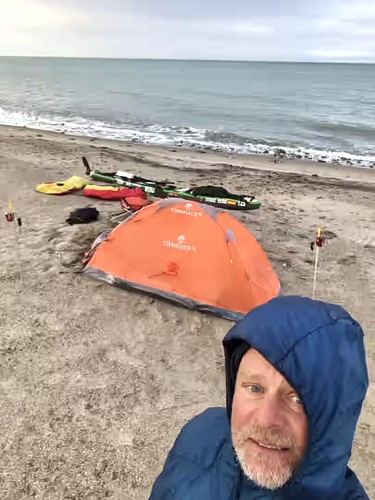
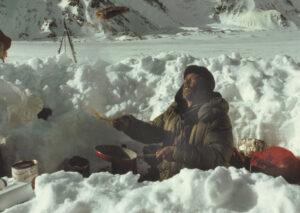
De la Rosa at a campsite. Photo: Antonio de la Rosa
Other Northwest Passage expeditions
Once considered an “impossible” route, the Northwest Passage has seen more expeditions as our warming climate opens the route for longer periods. While far from de-fanged, the route has moved from near-impossible to merely extremely difficult.
De La Rosa’s July start might have been inspired by the success of the Arctic Cowboys in 2023. After aborting their first attempt in 2022 after just 300km, veteran Texas kayak racers West Hansen, 61, and Jeff Wueste, 63, made some changes: double kayaks instead of singles and two new members — endurance paddler Eileen Visser of New York and ultramarathoner Mark Agnew of the UK.
In 2023, the foursome showed up a month earlier, in early July, and became the first people to paddle the entire Passage in a single season. They routinely covered 60km or more in a day, helping to offset many windbound periods, particularly during the second half of their journey, as their daily paddling window shrank and the nights lengthened.
While De la Rosa is heading east to west, Canadian Karl Kruger is attempting to SUP from west to east. Like De la Rosa, Kruger has a customized board that he can also pull as a sled. Unlike De la Rosa, Kruger’s expedition is broken into manageable chunks. Starting in 2022, he is trying to knock over a section of the Passage each summer. In the mid-1980s, a pair of catamaran sailors did the same, covering several hundred kilometers each summer over three years.