Fay Manners is now well-known in alpine climbing and extreme skiing, but few would imagine that just four years ago, the UK-born, Chamonix-based Manners was a data scientist. Looking closely, however, one may still see the disciplined, methodical approach in the way she handles her climbing career.
“I want to show that there isn’t an age limit on reinventing yourself,” says Manners, 39. “People often say a sporting career is over by your thirties, but mine only began then. I was also told growing up that a woman couldn’t make a career in mountain sports, and that turned out not to be true, either.”
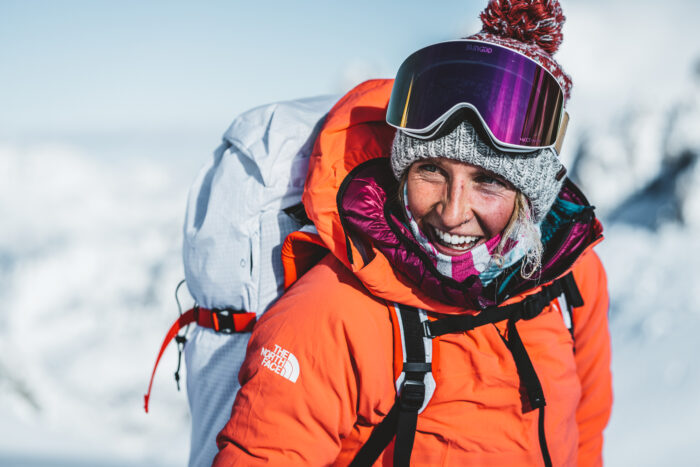
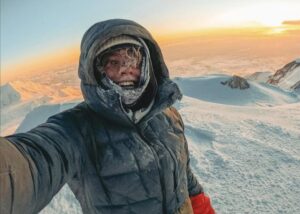
Fay Manners, from data scientist to professional alpinist. Photo: Courtesy of Fay Manners
All in
When she decided to change her life to focus on alpinism, she did so at full tilt. Manners climbed line after line on varied rock, in different styles. She progressed quickly and started opening new lines in 2023 with a mixed winter route in Norway. She followed up with an expedition to Pakistan with the Pou brothers, themselves experts at new routes. They opened a new line on Trango II:
“With them, I learned a lot and got highly motivated to open further routes,” she told ExplorersWeb. “However, I first worked hard to develop as an all-around climber, mastering all styles, terrains, and techniques.”
Manners was a methodical, analytical learner, but also a reflective one. She carefully considered what really motivated her. She also became a master at reading the rock and spotting hidden, beautiful lines ripe for a first ascent.
Cool in uncertainty
The second skill that helped her in her career was the ability to venture into the unknown and feel just okay in uncertain terrain.
“It’s an essential skill, because no matter how good you are at spotting potential lines, things may unravel in a different way than expected, from loose rock to more difficult sections than expected [or] changing conditions,” she explained. “Things rarely go completely according to plan, and you need the ability to adapt.
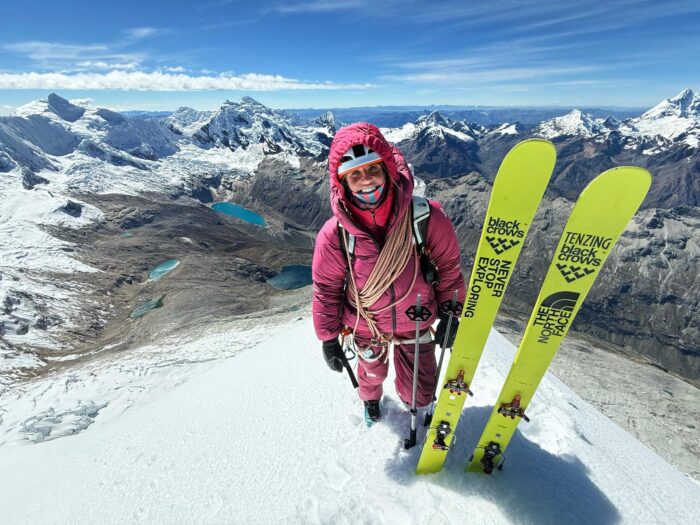
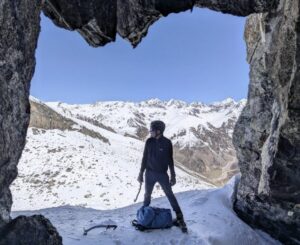
Fay Manners in the Andes. Photo: Courtesy of Fay Manners
“I mainly look for something that can challenge me and where I can learn a new skill,” she added. “One of the main ways I choose a particular route above others is to satisfy some curiosity that I have.”
From the Alps to the Andes
By now, Manners has become a year-round professional climber. In 2026, she has mostly climbed nonstop at home in the Alps, but the year’s highlight so far was an expedition to Peru’s Cordillera Blanca with Marco Malcangi of Italy.
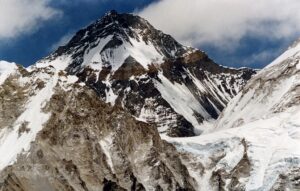
The pair were on their first trip to Peru. Planning to explore ski mountaineering objectives, they joined a team of local climbers led by Cesar Vicuna. Together, they made an alpine-style, single push ascent up the southwest ridge of 6,162m Ranrapalca. That route had been climbed only once before, in 1980, by a Swiss team. Since then, the mountain had remained inaccessible due to the maze of seracs and crevasses on its lower half.
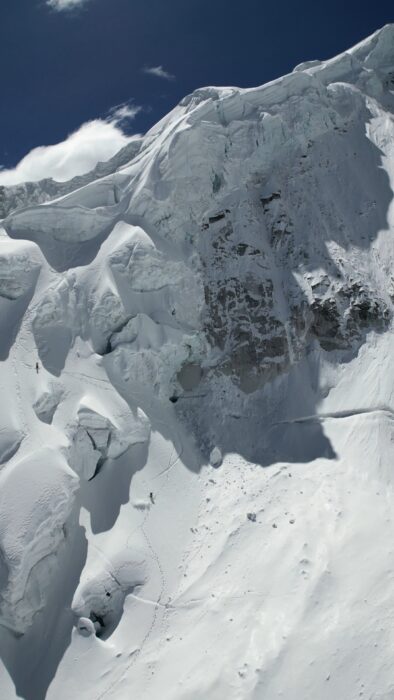
The biggest challenge on Ranrapalca was the lower part of the route, a maze of seracs and crevasses. Photo: Courtesy of Fay Manners
The team somehow found a passage “through fragile snow bridges, jumped numerous crevasses, and climbed through steep serac terrain,” Manners recalls.
From the top, they made the first-ever ski descent of the mountain. It could also well be the last, as it was extraordinary that the snow conditions, especially on the glaciers, permitted them to find a route. No wonder they called the ski line Acceso momentaneo (“Momentary access”), which it likely is.
They graded the ski 5.1 E3 900m. (In skiing, the 5.1 technical grade denotes steep, sustained descents with 45° to 50° slopes over hundreds of meters, while the E3 exposure grade warns that a fall is highly likely to send you over a cliff with a high probability of death, according to Adrian Earlyup‘s ski grade notes.)
Next, Manners and Malcangi climbed and skied down the north ridge of the beautiful Artesonraju, the famously spiky peak chosen by Paramount Pictures for its logo. Worsening weather and complex conditions forced the pair back without reaching the summit. Nevertheless, the climbers found no record of a previous ski descent of that ridge.
“Both routes reinforced our impression that the Cordillera Blanca offers exceptional ski mountaineering, where the principal challenge lies not in the steepness of the skiing itself, but in solving complex alpine terrain while remaining on skis,” Manners said.
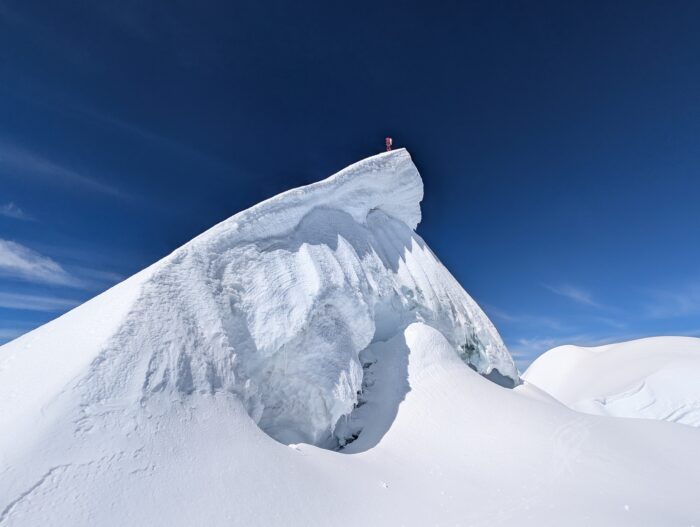
The summit of Ranrapalca was a true Andean ‘meringue.’ Photo: Courtesy of Fay Manners
All-year planning
Overall, Manners endeavors to make the most of each season. “I like to plan my year, but…keep my objectives flexible, so I can adapt to conditions,” she explained. “In winter, for example, I’m usually choosing between steep skiing and mixed or ice climbing, depending on what the mountains are offering.
“If it’s a great ice season, I’ll focus on ice climbing. If the snowpack is good, I’ll dedicate more time to steep skiing. Last winter, I spent much more time mixed climbing because the skiing conditions were not suitable for the kind of steep skiing I enjoy.”
Not surprisingly for a skier, Manners admits that summer is her least favorite season. “I don’t enjoy the heat, and I find it much harder to perform well, ” she said.
Given climate change, the Alps are not as great a choice as they used to be.
“Sometimes I try to organize an expedition during that period so I can escape the hot Alps, while other years I use it as a time to train, recover, and prepare for bigger objectives. Then in autumn, especially October and November, I often feel at my strongest on rock after a summer of climbing, so it’s a great time to work on difficult rock projects.”
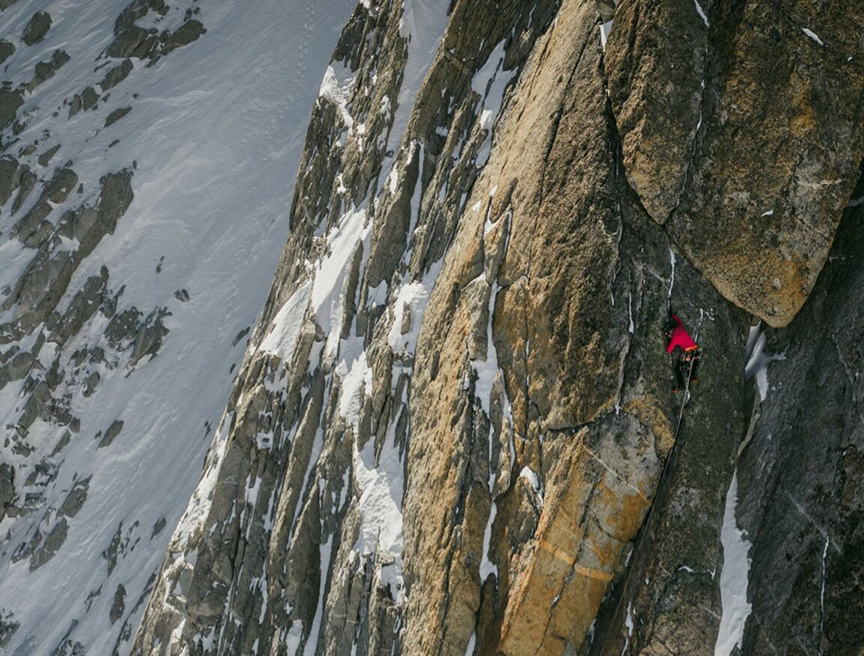
Mixed climbing in the Swiss Alps. Photo: @janvirt.official
Manners wishes she could spend more time exploring the Himalaya, which she considers her natural terrain: high, cold, and still wild enough to explore. Interestingly, it’s not lack of time or funds that keeps her away from the Greater Ranges, but the lack of a suitable team.
“Expeditions like these depend so much on having the right partners, and I haven’t found the right people to share those objectives with,” she said. “Until [I do], I’ll look for routes there that I can safely tackle solo or wait until the right team comes together.”
Climbing with women
We asked Manners if she enjoys climbing in all-female teams and how women-only teams differ.
“I actually don’t have that many female climbing friends, and I often actively seek out female partners,” she says. “Sometimes I’ll even climb with women who are less experienced because I believe that seeing women climbing together sends a powerful message, and if that inspires more women to get into the mountains, it’s worthwhile.”
Manners attended an all-girls school and found it easy to connect with other women.
“I find I can relax, laugh, joke, and completely be myself,” she said. “The atmosphere tends to be very supportive, and we’re comfortable talking openly about our feelings and doubts without feeling the need to put on a brave face or prove anything.”
That said, she also really enjoys climbing with male partners. “For me, it’s never about one being better than the other. Different people bring different strengths, and I value having both kinds of partnerships and the different experiences they offer.”
Her latest escapade is a new route Manners opened with Mathilde Badoual two weeks ago. Called New Aera, it’s a 6C ED+ line on the northwest face of Nordend (4,609m) in the Swiss Alps. Manners first eyed that potential route a year ago.
The Chamonix community
Manners lives in Chamonix, Europe’s climbing mecca in the French Alps. She considers it home, but openly speaks about both its lights and its shadows.
Chamonix is an incredible place to build a life in the mountains. It isn’t always easy, though. Sometimes it can still feel like a bit of a boys’ club, and I don’t always feel like I fit in. I’m British, I came to mountaineering later than many people, and I didn’t grow up in that culture.
At the same time, I’ve met some incredibly strong female partners there, and being surrounded by such a high standard of climbing constantly inspires me to improve.
She also believes there is no better place to be for those dreaming of becoming professional mountaineers. But there is, she cautions, other requirements of the job.
“Being a professional alpinist is about much more than training and expeditions. There’s also filming, writing, public speaking, working with sponsors, planning projects, and managing all the logistics that make those projects possible. I’m still learning how to balance all of those different roles while making sure the sport itself remains at the center of what I do.”
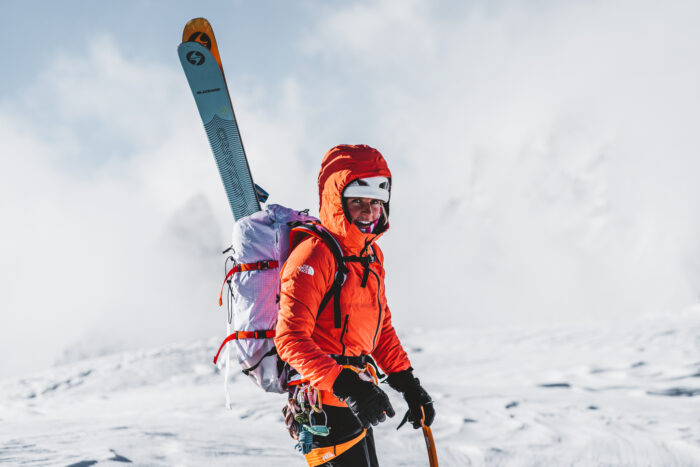
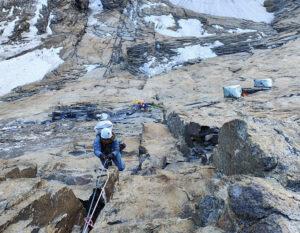
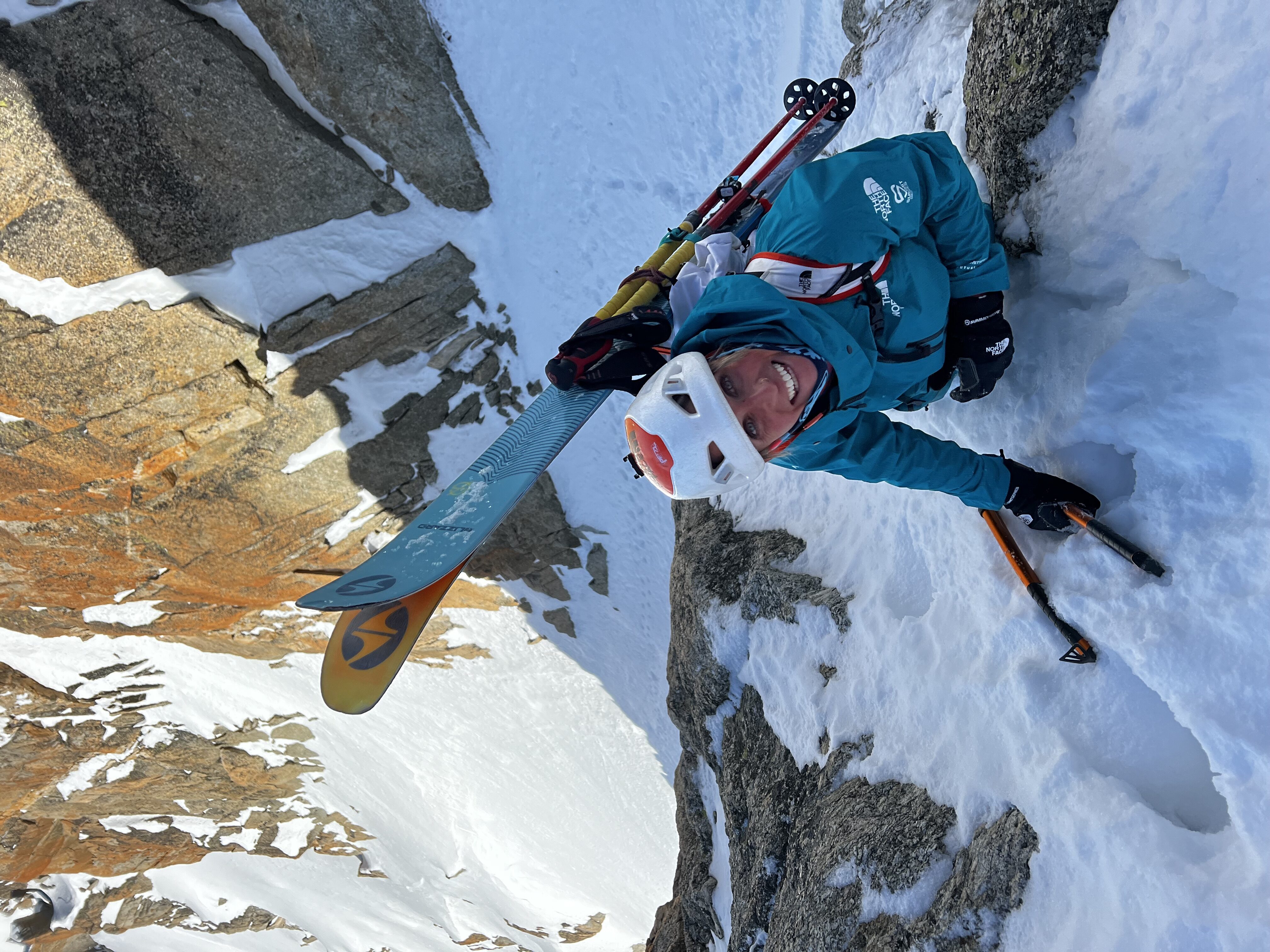
Fay Manners at her day job. Photo: Courtesy of Fay Manners
Lost friends
Living in Chamonix also means losing friends to the mountains. Like many pros in the Chammonix Valley, she often partnered with Guillaume Pierrel, who perished in Pakistan some weeks ago. Her thoughts about him say a lot about what it means to be a mountaineer.
I’m always sad to keep losing friends in the mountains, especially those who were my partners and with whom I shared so many moments and projects. It makes it even harder when they were making the same choices I would have made. I understand why they were there, because I go into the mountains for the same reasons … the passion, the curiosity, and the drive to push beyond what’s comfortable.
I can’t look at them and think they shouldn’t have been there. Their deaths force me to confront the reality of what we do, but they don’t make me want to stop.
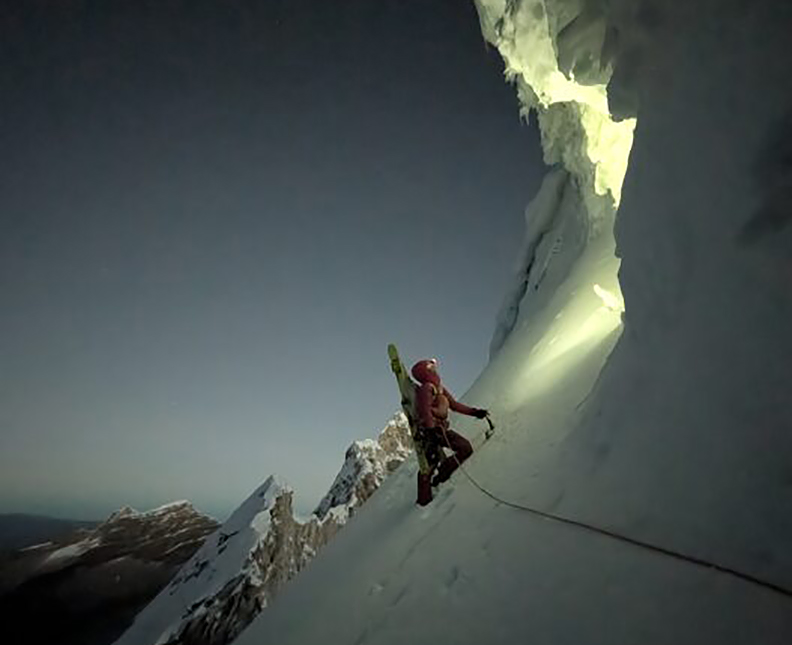
Climbing after sunset. Photo: Courtesy of Fay Manners