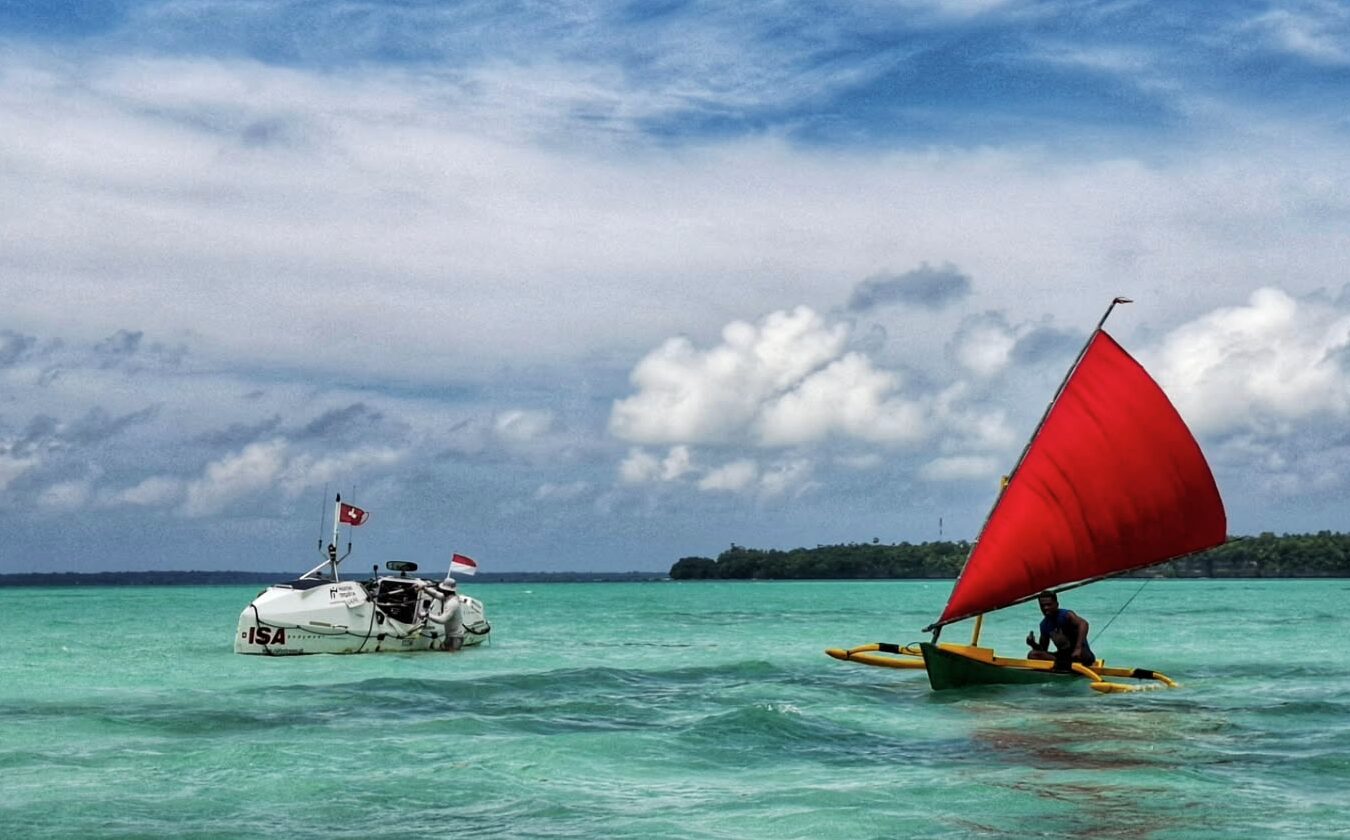
Since out last roundup, Louis Margot has completed the rowing part of his round-the-world expedition, two independent crews have taken to the Pacific, two races have started, and Dave Bell has made it to Australia.
Pacific Ocean
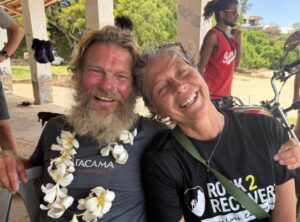
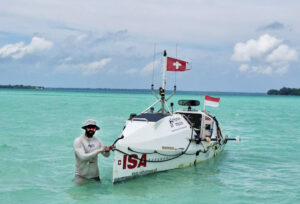
Louis Margot (CH): Louis Margot has completed the fourth and final rowing stage of his round-the-world expedition by rowing solo from Peru to Indonesia. He paused at several islands in the Indian Ocean over the last few months en route to Indonesia to wait for the right weather window.
Initially, he planned to row to Singapore, but changed his route due to the maritime traffic. Instead, on May 27, he ended the row in Surabaya, Indonesia. In all, he has covered 29,339km in 421 days alone at sea.
Shortly after landing in Surabaya, he hit the milestone of 1,000 days since leaving Switzerland. “I’m still far from home, but closer than ever,” he reflected.
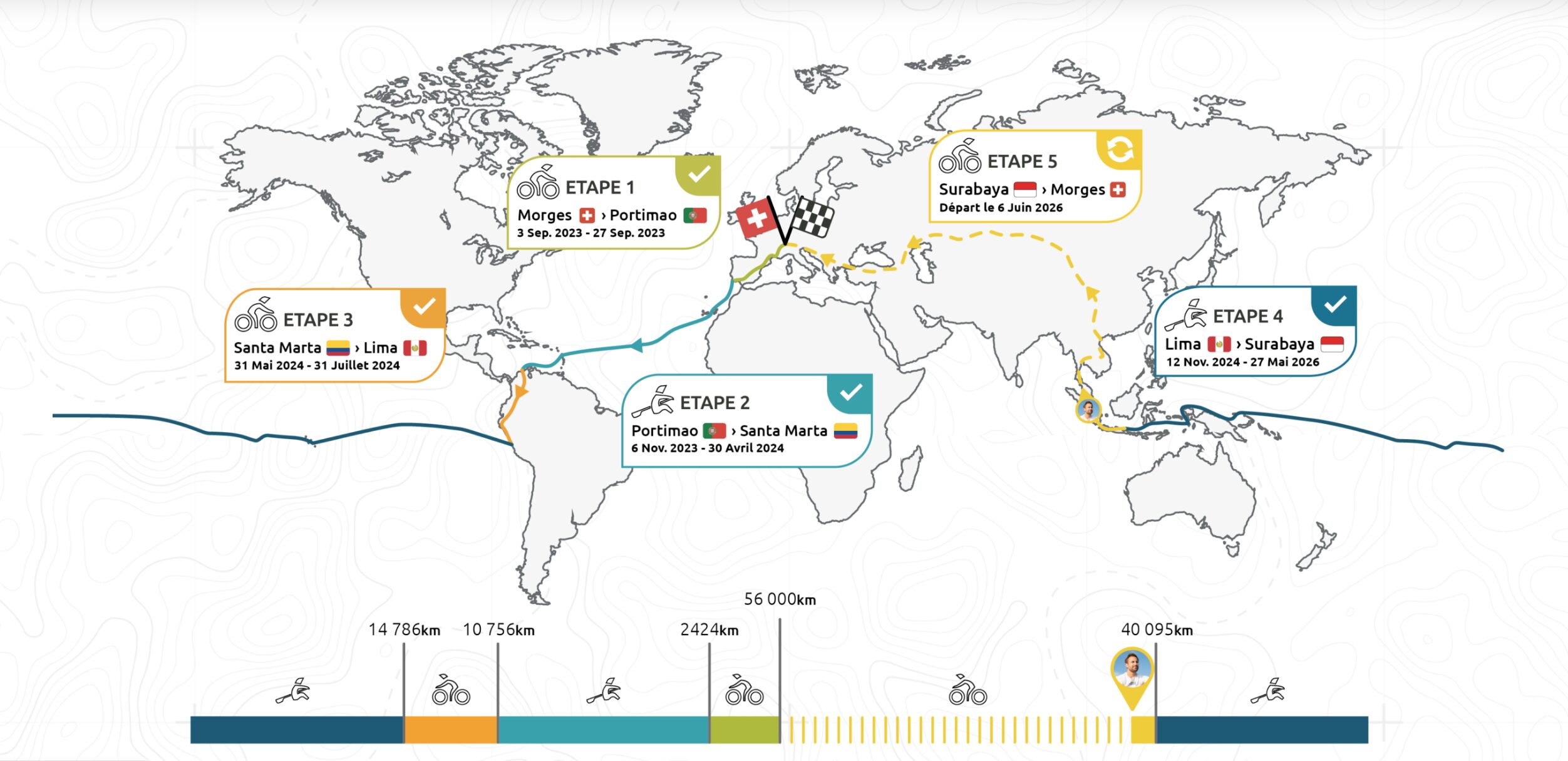
Louis Margot’s route around the world. Image: Human Impulse
On 7 June, he began the final leg. The goal of this stage is simple — get home to Switzerland. So far, he has cycled over 1,000km through Java, crossed the Sunda Strait in a borrowed kayak, and is now cycling across Sumatra to the Strait of Malacca.
Two oceans
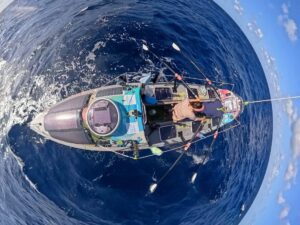
Dave ‘Dinger’ Bell (UK): Bell started his solo row across two oceans in November 2025. Setting off from Peru, he is rowing across the Pacific to Australia and then continuing across the Indian Ocean to Mauritius.
Throughout May, he was crossing the Coral Sea, and for much of this, the wind pushed him in the wrong direction. He needed to move west but was constantly bucking southerly winds.
At one point, when a large wave hit, his boat almost but not quite capsized. Nevertheless, it rotated so much that Bell’s head was in the water. He managed to stay in the seat, and luckily, all of the electronics stayed dry. A lot of water ended up in the cabin, soaking his kit and accidentally activating his EPIRB. The coast guard picked up the signal and contacted Bell’s girlfriend. After some frantic inReach calls, Bell confirmed he was okay.
At the end of May, after 202 days at sea, Bell finally saw Australia. He picked his way through the Great Barrier Reef and was preparing to go through the Torres Strait — a huge moment. His team believes he is the first known person to cross it in a rowing boat. Though it was well over halfway in terms of distance and time, for him, it was the psychological halfway point.
Once through, he spent a few days on the para-anchor, checking over the boat and all of the equipment. He wanted to figure out why his batteries were losing charge so quickly. Now he is pulling away from mainland Australia and about to head into the Indian Ocean.
World’s Toughest Row
The World’s Toughest Row race started on June 9, the counterpart to the company’s annual Atlantic Race. Compared to the more common Atlantic route (from the Canary Islands to Antigua), this route sees far fewer rowers. This year, five teams have entered and are battling 4,500km across the mid-Pacific from Monterey, California, to Kaua’i, Hawaii.
Weather delayed the start of the race by a few days, and the initial heavy conditions led to several mishaps. A mother-and-son duo snapped two oars, and one four-person crew had multiple knockdowns. Everyone suffered from seasickness. Thirteen days into the row, this has been one of the most challenging starts to the race.
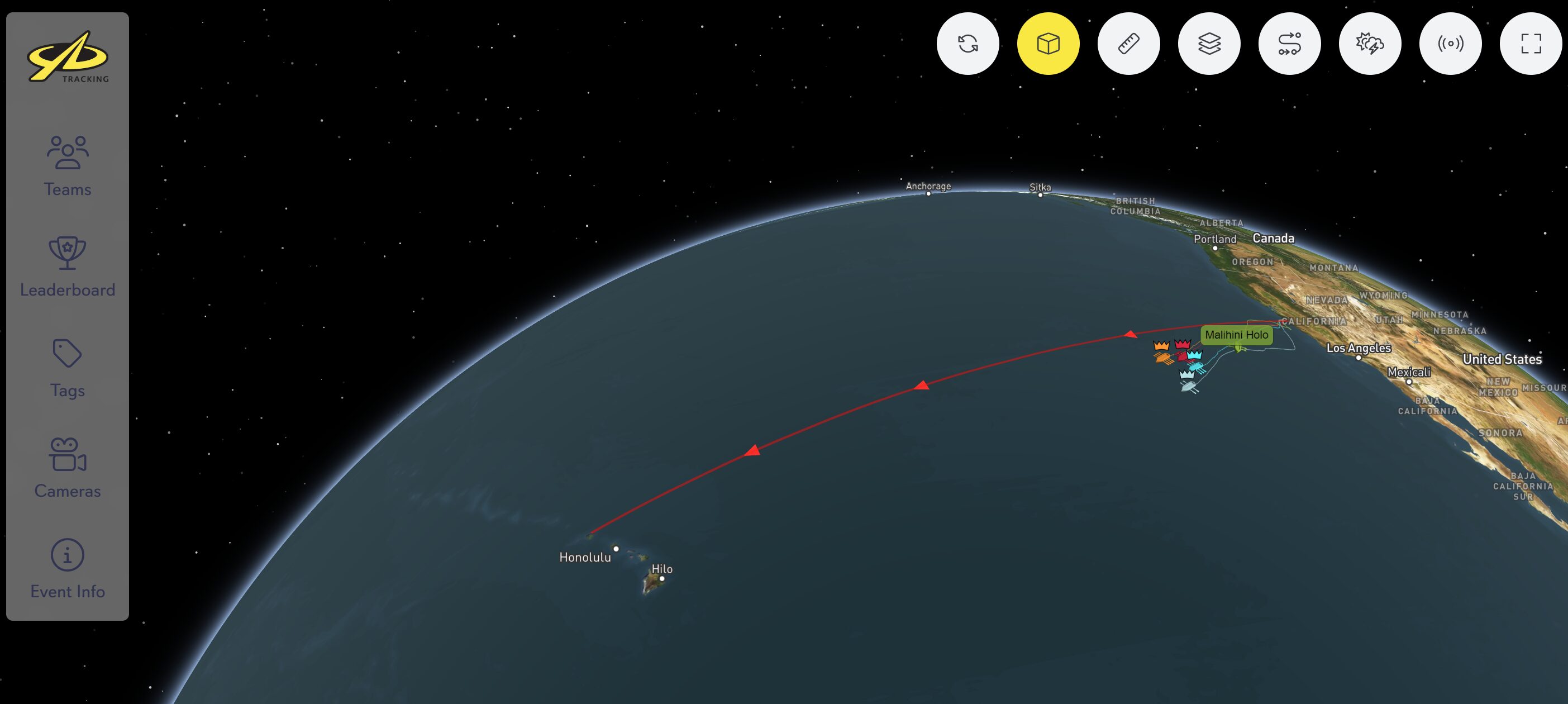
The positions of the crews in the 2026 World’s Toughest Row. Photo: World’s Toughest Row
The leading boat is the U.S. crew, Foar the Brave, which has covered 1,075km. Not far behind are Liz and Andrew of the Oceanways team. They have actually rowed a larger distance, 1,277km, but winds have pushed them so far off course that they are actually further from the finish line than Foar the Brave.
Moar Than Us, Row for Life, and Malihini Holo have covered 1,001km, 975km, and 792km, respectively.
California to Hawaii
Kelsey Pfendler (U.S.): Pfendler is solo rowing the Pacific from California to Hawaii. She started on May 21 and has covered 65% of her 3,776km route. She wants to become the first American woman and the youngest woman (at 31) to row the mid-Pacific solo. She would also like to break the current speed record for a female soloist, which is held by Lia Ditton, who completed the route in 86 days, 10 hours, and 5 minutes.
She previously rowed this route as part of The World’s Toughest Row. She was the skipper of a four-woman crew. Despite tricky currents, capsizes, and equipment failures, Pfendler knew she wanted to do it again, but as a soloist.
As usual, the hardest part has been escaping the California coast. For the first week, she battled westerly winds. Sometimes, they were so strong that moving forward was almost impossible, and the aim was simply not to lose mileage. Eventually, after nine days, the wind shifted, and she managed to turn west toward Hawaii rather than continue to hug the coastline.
Last week, she crossed the halfway point of the row. Managing this in just 25 days, she is well on her way to breaking the speed record. Since then, she has had to contend with sweltering heat and almost no wind.
Washington to Hawaii
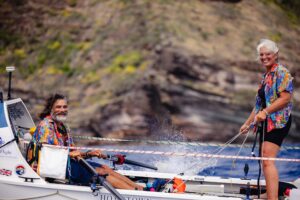
Row West Pacific (U.S.): Gregory Anderson, Wilton Ngotel, Joshua Dukes, and Johnny Martinez are rowing 4,988km across the Pacific from La Push, Washington, to Maui, Hawaii. They started on May 2 and should reach Hawaii within the next few days, well within their projected 50 to 70-day row.
The first section was extremely challenging, as storms buffeted their little craft. “The first two days, we all got sick really bad,” Dukes told MauiNow. “We had a couple of nice days of weather, and then it was just storm after storm. And the first storm we got wasn’t crazy, but it was probably 20 to 25-knot winds, and it was blowing in the wrong direction…The whole time the boat is just bouncing up and down and shaking and rattling.”
The team admitted on social media that they thought the journey would be less monotonous and more exhilarating. Instead, much of it has felt like Groundhog Day with “overcast skies, light winds, no scenery, no boats, and no animals.” Reaching the halfway mark on May 30 gave them all a huge boost. To celebrate, they treated themselves to some peanut M&Ms.
In early June, their watermaker broke. They were able to fix it by swapping out the pump from their spare, but that also broke within a few days. For the last 10 days, they have been pumping water by hand, an extra hour of work per person every day.
Around Britain
GB Row: This year, two boats have embraced the GB Row challenge. Starting at Tower Bridge in London, the crews will row approximately 3,200km clockwise around mainland Britain.
At the moment, the five-person crew Rowmads has covered 675km and is ahead of the six-person crew Nautilus by 75km. Both crews are working their way along the south coast and getting ready to move around the bottom of Britain onto the western coastline.
In the first week, the crews had to overcome the seasickness that afflicts most rowers. Although the route might seem simple compared to an ocean crossing, the UK’s powerful currents and tides, and ever-shifting winds, create unique difficulties. You can only row during tidal windows and have to navigate the coastline while avoiding busy shipping lanes.