Since our last ocean rowing roundup, the 2026 Pacific World’s Toughest Row has finished, speed records have fallen on the Pacific Ocean, and rowers battle across four of the world’s five oceans.
Pacific Ocean
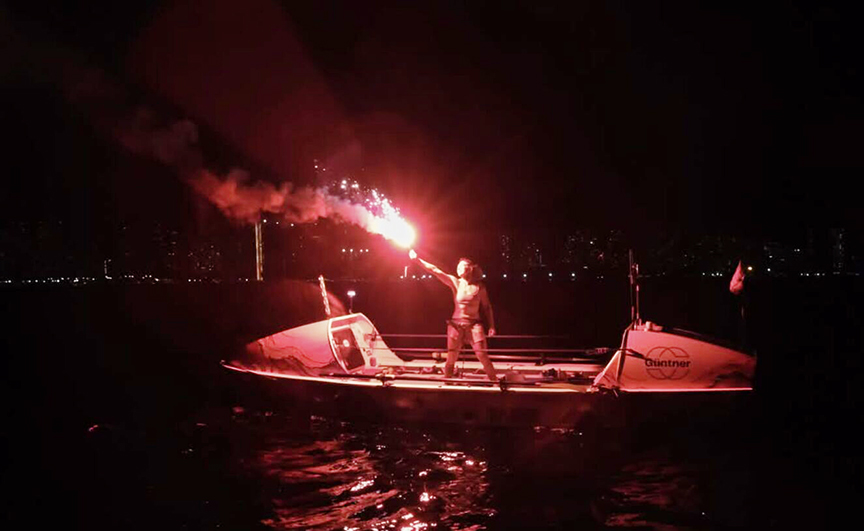
Kelsey Pfendler (U.S.): Pfendler has completed her 3,900km row from Monterey, California to Hawaii in 43 days, 18 hours and 12 minutes. The 32-year-old river guide shattered the overall speed record for the California-Hawaii route by more than eight days and also lowered Lia Ditton’s women’s record by more than six weeks. In doing so, she is now the fastest person and the first American woman to complete the crossing solo.
As usual for this route, the initial two weeks were the toughest. Currents and winds along the California coast made it hard to pull away from the continental shelf and reach the trade winds trending west toward Hawaii.
“I was rowing, but I was crying,” Pfendler told Hawaii News Now. “I was just trying to make bargains with the wind, like what if you stopped for a little while, and I’m just talking to the wind, trying to convince it to stop blowing. You can’t make deals with the weather, but I was trying.”
To maintain a little progress, she adapted her sleeping pattern so that she rowed in 45-minute shifts separated by 10-minute naps. She averaged only around a few hours of sleep a day during the first week. The sleep deprivation became so severe that she began hallucinating.
“The majority of it was auditory hallucinations where every noise my boat was making was, like, a person’s voice, and it just felt like pretty often like a chorus of people talking to me in very understandable words,” she said. “It was very unsettling.”
Then, on day seven of the row, she realized that her solar-powered desalinator couldn’t produce enough because of limited solar power, so she had to break into her emergency bottled water earlier than planned.
Despite the issues at the start of the row, once Pfendler was beyond coastal waters, she really picked up the pace. She admits she had not expected to arrive so quickly, but that the favorable currents coming toward Hawaii accelerated her pace dramatically in the final days.
Pfendler was amazed to find hundreds of people cheering her on as she came into Honolulu Harbor. “I expected there to be 30 people…I honestly was overwhelmed.”
World’s Toughest Row: OceanWays has won this year’s World’s Toughest Row. Liz Wardley and Andrew Breen set a new speed record for a pair completing the 4,500km from Monterey, California, to Kaua’i, Hawaii in 35 days, 8 hours, and 25 minutes. As one of the smaller boats in the field, this is a huge achievement.
This event always has a smaller pool of entrants than the sister race in the Atlantic Ocean, but often features veteran rowers who previously competed in the Atlantic event.
This year, just five crews took part. As with Pfendler, the start of the row and pulling away from the coastline were difficult for everyone. The organizers called it “one of the most challenging starts we’ve seen.”
Initially, the pair sat in second place behind Foar the Brave, though they had technically covered more mileage than the four-person crew. Heavy headwinds pushed them off course, and they had to deploy their para anchor. Other crews suffered from broken oars, seasickness, and damaged daggerboards.
By the end of June, conditions had become more favorable, and OceanWays moved into the lead and stayed there. Throughout the row, however, very little separated the crews. All five groups have now crossed the finish line.
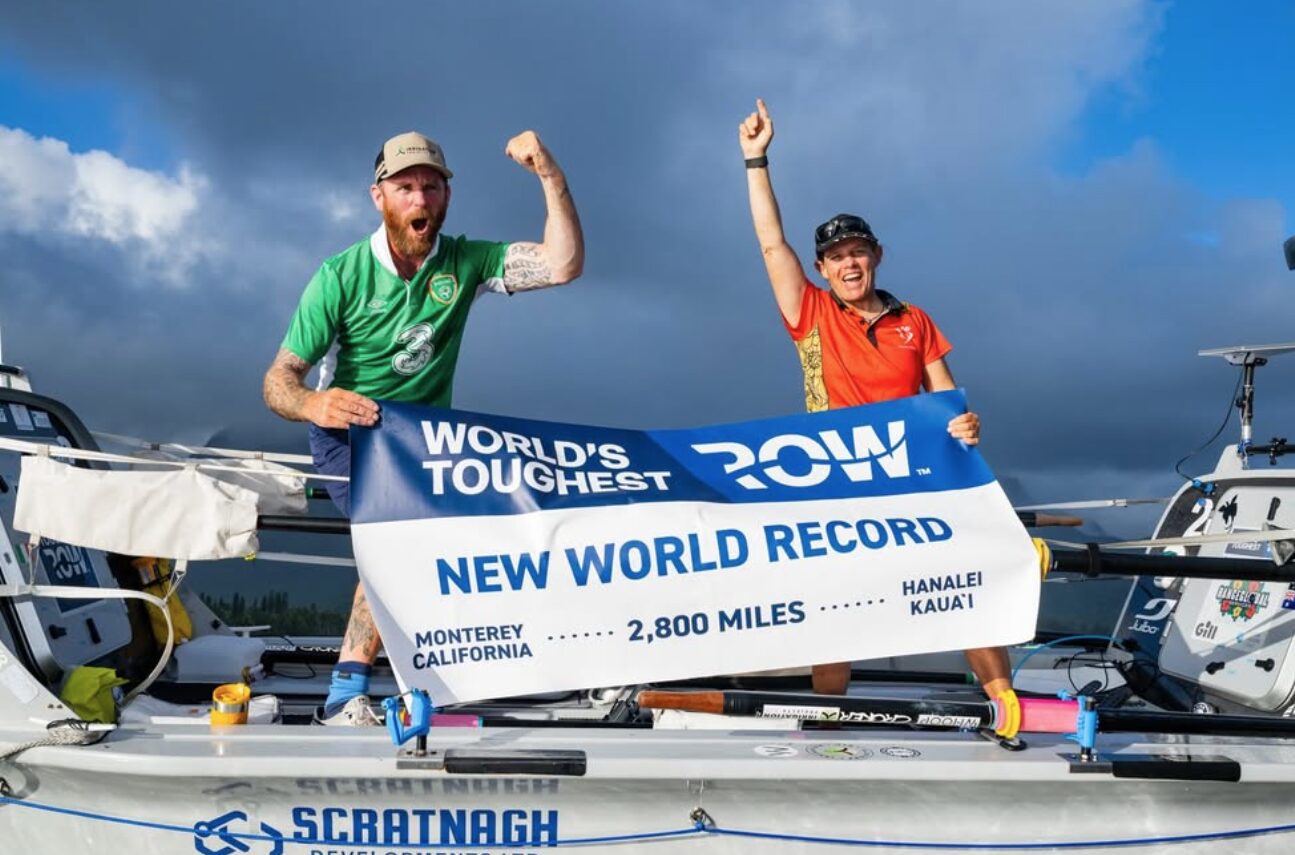
OceanWays takes first place in the World’s Toughest Row. Photo: World’s Toughest Row
Arctic Ocean
Team Arctic Row (CH): Roman Mockli, Florian Ramp, Ben von Mitzlaff, and Frederik Jacobs are attempting what they say is a first — rowing across the Arctic Ocean from Longyearbyen, Svalbard, to Scotland’s Orkney Islands.
Others have rowed sections of the Arctic Ocean, but no one is known to have tried this route before. “Our goal is to reach further north than the current record of 79°55’N, set by Polar Row in 2017. We plan to go as far north as conditions safely permit,” says Mockli. So far, they have completed just over 40% of the 2,291km route.
They started at the northernmost point in Svalbard on July 3, but had to stop just days later due to the weather. They then anchored in the harbor at Ny-Alesund for over a week, waiting for good weather.
They started rowing north again on July 14, and the next day reached 80°04′ latitude, the northernmost point they say a human-powered boat has reached. Note, however, that this claim is rather broad: In 2004, a group of kayakers retracing part of the Greely Arctic Expedition paddled 180 nautical miles south from Fort Conger, Ellesmere Island, at 81˚45′ to 78˚44′. And in 2011, Jon Turk and Erik Boomer hauled and paddled their kayaks around Ellesmere Island, reaching 83˚07′. While they were dragging the kayaks like sleds at that point, they began paddling open water well north of 80˚. Although these expeditions were different, the rowers need to tighten their claim.
The Arctic Row team is now continuing south with the East Greenland Current toward the island of Jan Mayen, their halfway point. From there, they will row towards Iceland and the Faroe Islands before heading to the Orkneys. Their exact route will depend on the sea ice.
Indian Ocean
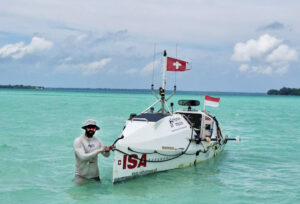
Dave ‘Dinger’ Bell (UK): Bell has now been rowing across the world’s oceans for eight months. In November 2025, he left Peru and paddled across the Pacific to Australia. At the end of May, he crossed the Coral Sea and was closing in on Australia. From here, he picked his way across the Great Barrier Reef and through the Torres Strait.
From there, he spent a few days on the para anchor to sort out some electrical issues. After more weeks of rowing, he once again deployed the para anchor, this time because heavy winds were pushing him in the wrong direction. When he attempted to row again, the swell almost capsized the boat, so he went back to the para anchor.
By the end of June, he entered the Indian Ocean and reached Australia. This was an important milestone because from here, he would assess his timing to see if it was possible to continue. It was.
In early July, he had pulled away from mainland Australia and passed the last of many atolls, the final land he would see until Mauritius. If he reaches that island east of Madagascar, he will have completed the longest-ever unsupported single-stage row.
Monkey Fist (UK): Darren Taylor, Glyn Roberts, Lara Vafiadis, and Susannah Cass are rowing from Carnarvon, Australia, to Mombasa, Kenya, across the Indian Ocean. They are hoping to become the first mixed crew to row from Australia to Kenya. They started on July 11. After one week, they had covered 700km of the 8,200km journey.
As with many crews, they suffered from seasickness in the first few days as they became used to the boat’s rocking. They then moved to a slightly more southerly route to avoid some “funky currents.” Despite this, the weather has been tricky, with huge swells from every direction. This makes everything on the boat harder, especially sleeping.
Atlantic Ocean
Min Amy Xu and Ran Li: Min Amy Xu (U.S.) and Ran Li (CN) are rowing the North Atlantic from St. John’s, Newfoundland, Canada, to Penzance in the UK. They began on June 26, and so far, the pair are speeding along and have covered 45% of the 3,408km route. They have provided few updates, but their tracker shows they are making good progress.
Row Aurora: Dawn Smith (UK) and Paul Lore (U.S.) are the second pair attempting to cross the North Atlantic from St John’s, Newfoundland, to the UK. They have a slightly different endpoint to Xu and Li; they are planning to land at Burnham on Crouch, which adds an additional 300km. Otherwise, their general route is similar. They also left on June 26 and have rowed just over one-fifth of the 3,797km distance.
Both are experienced ocean rowers; Smith has now completed six ocean rows. This expedition makes up part of a larger journey. The pair completed the World’s Toughest Row on the Atlantic earlier this year and were the fastest mixed pair in the event. Rather than stop in Antigua, they decided they would row back to the UK via Canada.
After a few days getting used to life back on the boat, they slipped straight back into their normal rowing routine. This row is in the North Atlantic, so cooler weather one of the biggest differences to their row earlier this year. The water is just a few degrees above freezing, and thick fog can appear suddenly. This has drastically reduced their visibility and has made everything damp.
Over the first few weeks, the weather has been changeable. At times, the water has been relatively calm, so they have had no assistance from winds or currents. At other times, they have both had to row at the same time to keep themselves moving in the correct direction against the wind and waves, or put themselves on a para anchor.
A distance milestone came on July 11 when they passed 1,000km.
Around Great Britain
GB Row: This year, two crews are taking on the GB Row challenge and rowing clockwise around mainland Britain. After starting at Tower Bridge in London on June 15, the boats were initially neck and neck around the coastline, but the five-person Rowmads managed to pull away from the six-person crew Nautilus as they came around the south coast.
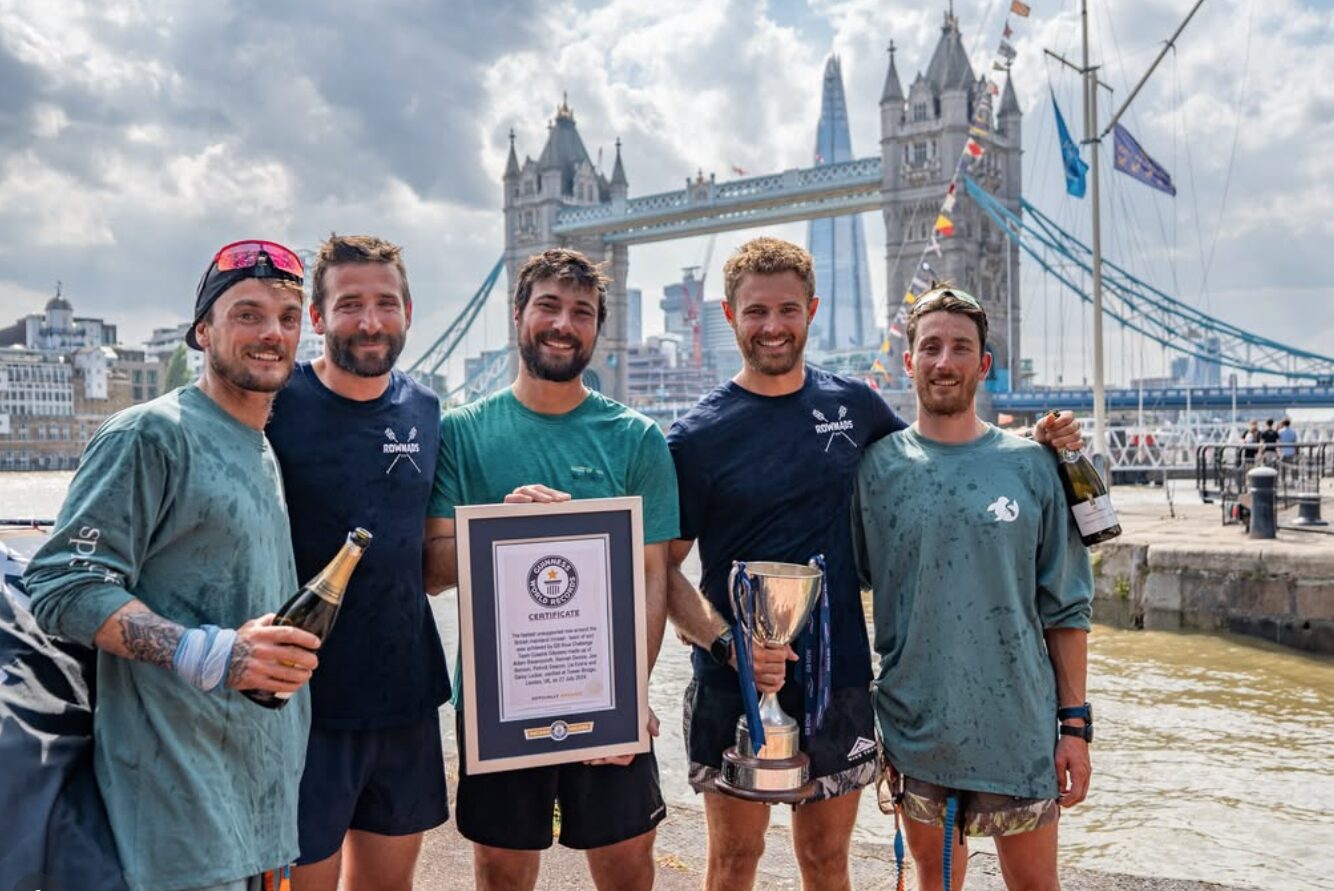
Rowmads are the first five-person crew to row around mainland Britain. Photo: Rowmads
They stayed ahead for the rest of the row. Conditions became slightly tougher as they proceeded through the Irish Sea and around Scotland. Faced bigger waves, they often used drogues to help stabilize their boats. Despite this, both crews maintained the pace for the entire row. They used their few days on the para anchor to sort equipment, wash clothes, and dry out their kit, so that they were ready to go as soon as conditions allowed.
Rowmads made it back to Tower Bridge in 32 days and 30 minutes, making them the quickest five-person crew to complete the route. Six days later, Nautilus finished in a time of 38 days, 3 hours, and 41 minutes.