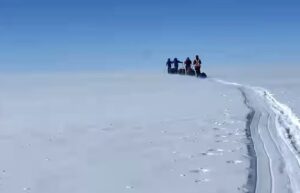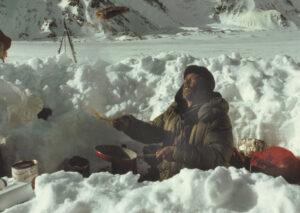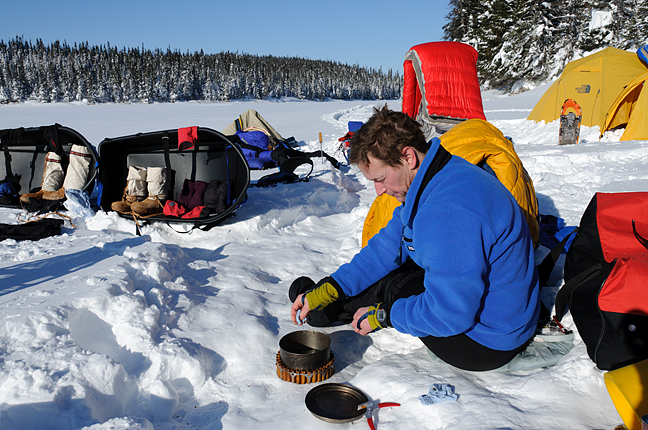
If you travel in the cold, you are more aware of water intake than a summer hiker, because every sip must be melted. This can be time-consuming: It takes half an hour to turn snow at -40˚ into a liter of boiling water. The amount of fuel carried depends on a group’s water needs, and these can vary greatly. I’ve traveled with partners who sweated so heavily, even at -25˚ or -30˚C, that they needed twice as much water as I did — about six liters/day versus my three liters. This includes water used to reconstitute meals. Most of this water must be at or near boiling.
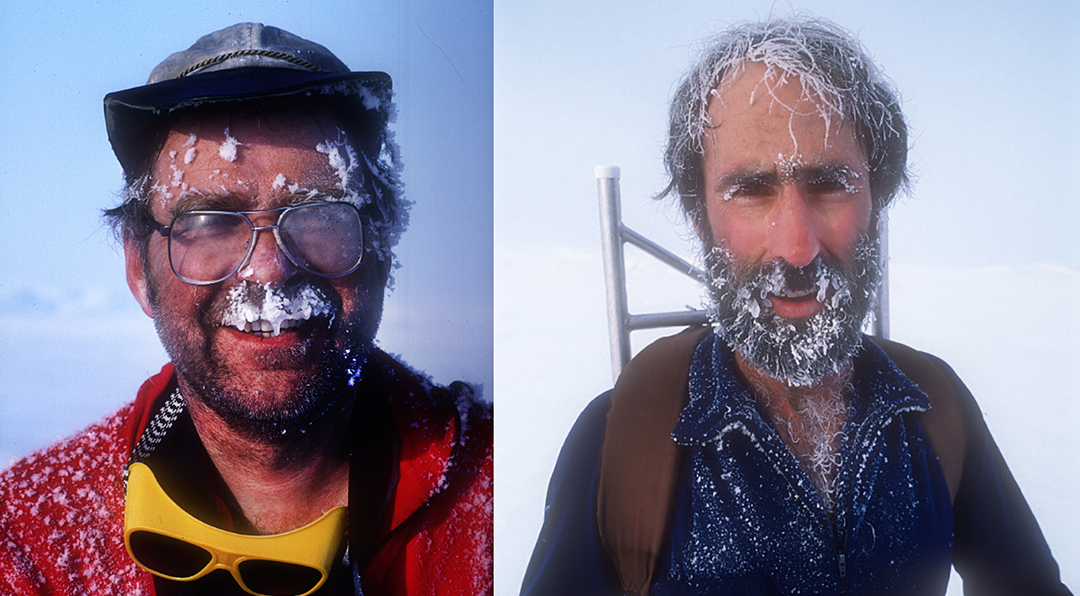
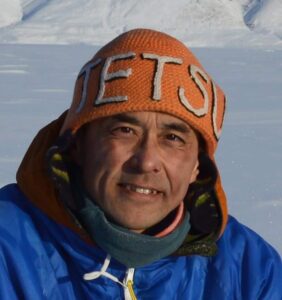
If you sweat a lot, you may need twice as much water as your non-sweaty partner. Even in the cold, it’s also hard for a sweater to keep glasses from fogging up. Photos: Jerry Kobalenko
Sweating is the most important factor in individual water requirements. In preparing for a trip with a new partner, I always ask, “Do you sweat a lot?” I do not, so my three liters/day is at the low end of the spectrum. On long days (more than eight hours) or in warm Arctic spring conditions, I drink an extra half-liter. On the longest, warmest days (12 hours plus), I might go through an entire extra liter. But in these milder conditions, melting snow takes less fuel and time.
Melt water the night before
Why do you need to bring drinking water near boiling? It’s more efficient to melt the next day’s water the night before and store it in a thermos overnight. In extreme cold, boiling water becomes merely pleasantly warm by morning. (Note that you never want to bring the water to a rolling boil if you cook inside the tent or vestibule because the thick clouds of steam will freeze on the inside wall.)
Sometimes at breakfast, I also fill or partly fill a one-liter Nalgene bottle if I’m anticipating a longer day. In the uninsulated Nalgene, the water needs to be hot so it doesn’t freeze before you can finish drinking it. Even water added to breakfast granola must be very hot, or else it will freeze by the time you eat your way to the bottom of a large bowl.
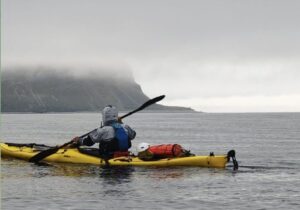
In non-desert environments, summer backpackers typically have easy access to fresh water. But like winter sled travel, sea kayaking requires water management. On multi-week paddles, my wife and I carry 22 liters of water in our double kayak. For the two of us, this lasts comfortably for three days — including water for washing — or four days, with rationing. Because it’s possible to be windbound at a waterless campsite, we try to top up every day. One nice thing about the Arctic: All water is good to drink, from the largest river to the scummiest puddle. Filters or purification chemicals are unnecessary.