On September 11, a three-person international team established a new route on 6,108m Chacraraju West in Peru’s Cordillera Blanca in the Peruvian Andes.
Raymond Eckland, Jon Zerain, and Josue Sanchez graded their 850m new line on the south face as WI4+ M5 90°, ED VI. They named it Shumaq Warmi.
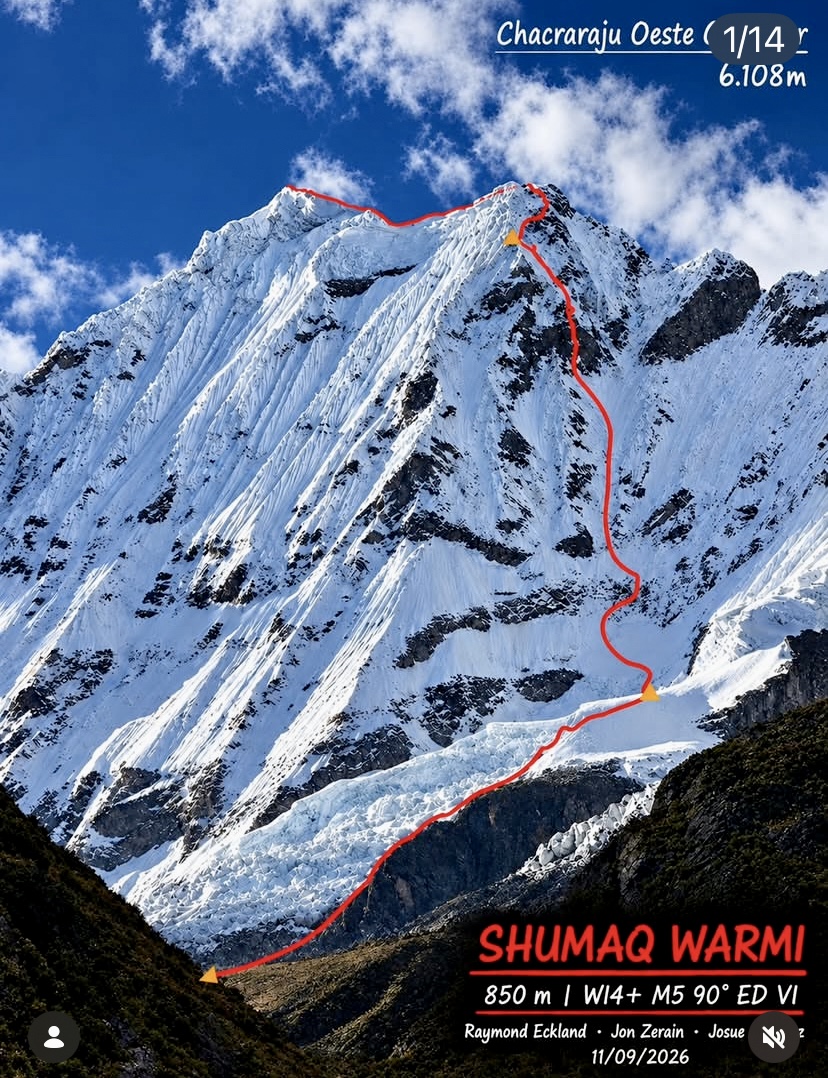
The new route on Chacraraju West. Photo: Josue Sanchez/Instagram
The climb took them six days. During the first two days, the weather kept them in their tents. On the third day, they climbed in near-winter conditions, with heavy snowfall at times. They broke trail in fresh snow, crossed precarious ice bridges, and large crevasses. Eight hours later, they set up their first bivy at the foot of the wall, beside a cave that gave them just enough space for the tent.
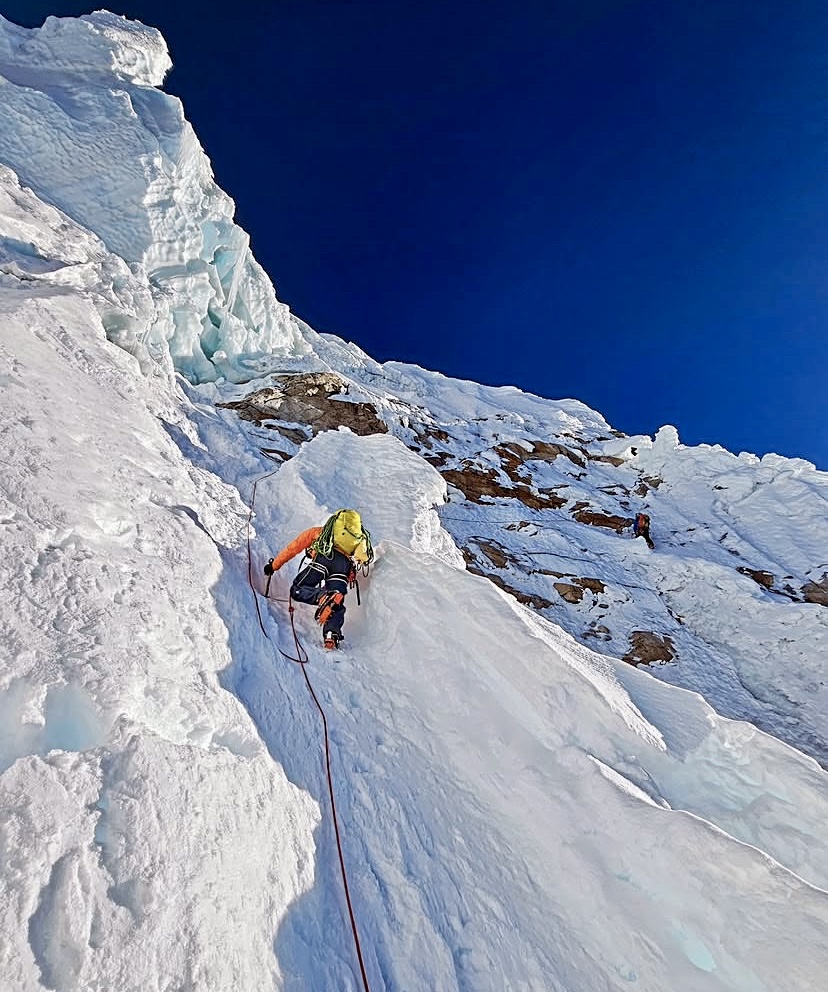
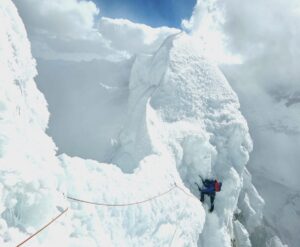
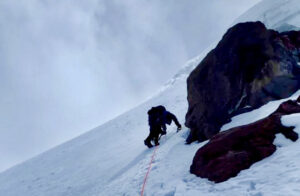
Opening the new route on the south face of Chacraraju West. Photo: Josue Sanchez/Instagram
Day four
They left at 4 am the next day. The trio climbed the 80° bergschrund of wet snow and entered a very exposed M5 of delicate moves leading to the couloir. They kept going until they passed — quickly! — through a zone where the rocks were falling like bullets to the crux of the route: a 70m wall of WI4+ ice.
Night fell, and it took two hours to find a “decent” place to sleep. They ate and slept as well as they could, sitting with wet boots inside soggy sleeping bags, with thermal blankets on top. It was one of the worst nights of their lives, according to the climbers.
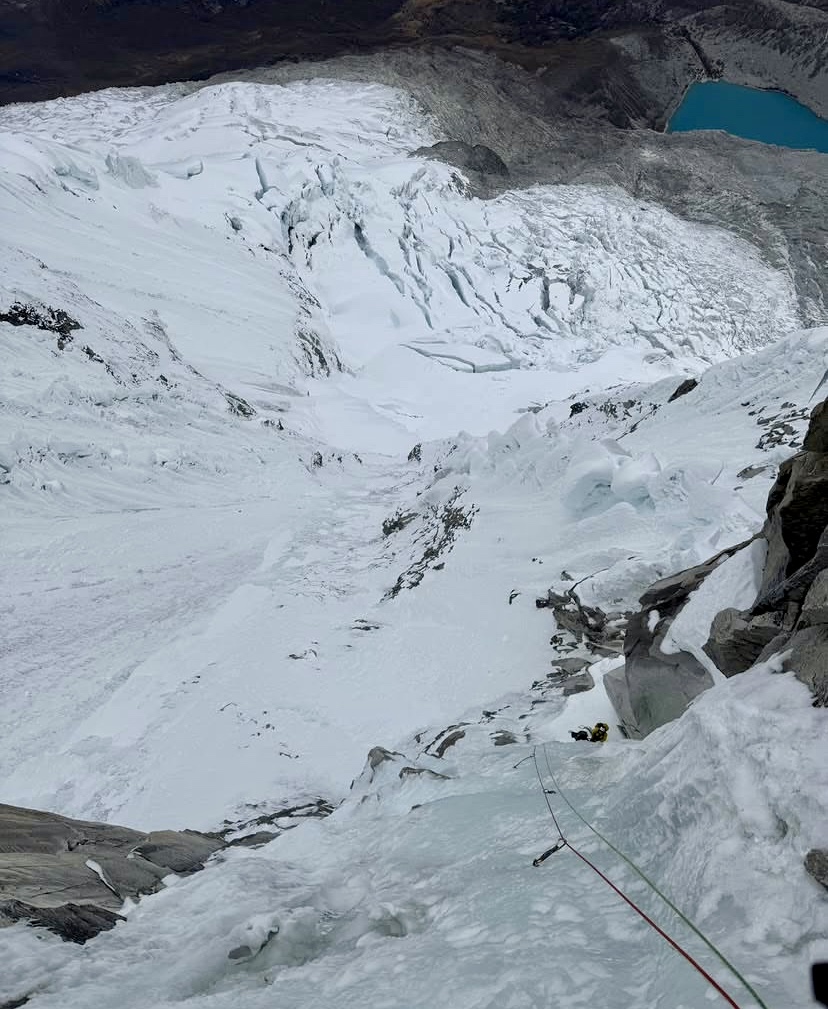
Looking down. Photo: Josue Sanchez/Instagram
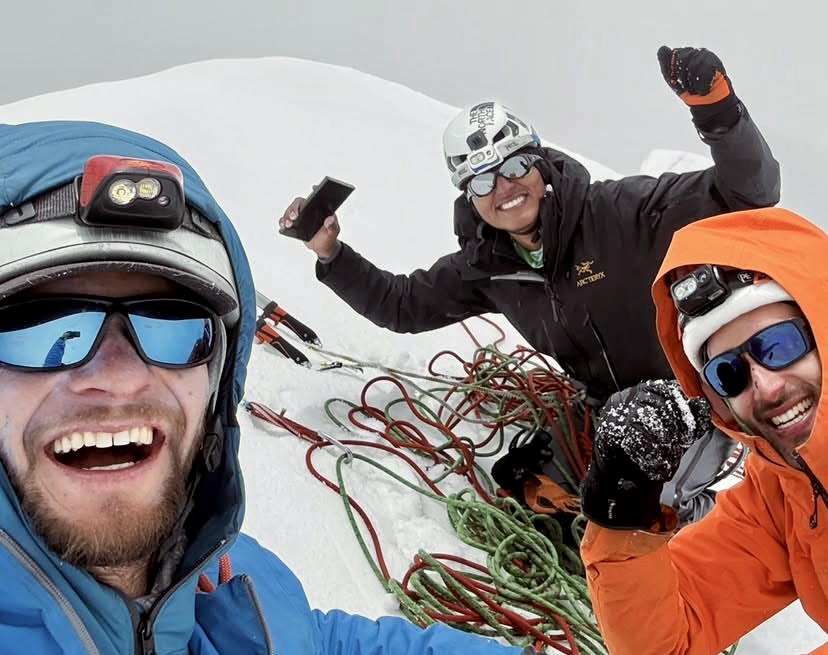
The climbers left for the summit, again at 4 am. They passed the last M5 crux and came out onto the summit shoulder at 10:15 am. An hour and a half later, Eckland, Zerain, and Sanchez topped out on the main summit of Chacraraju West.
The climbing was sustained, with pitches of 60–70° and very exposed mixed sections. Two pitches of pure ice were especially remarkable, reaching 90°.
For the descent, they made 13 rappels from the summit and short sections of downclimbing, then left the glacier and descended a zone of poor rock to Laguna 69, where a friend was waiting. They ended the long day at midnight.
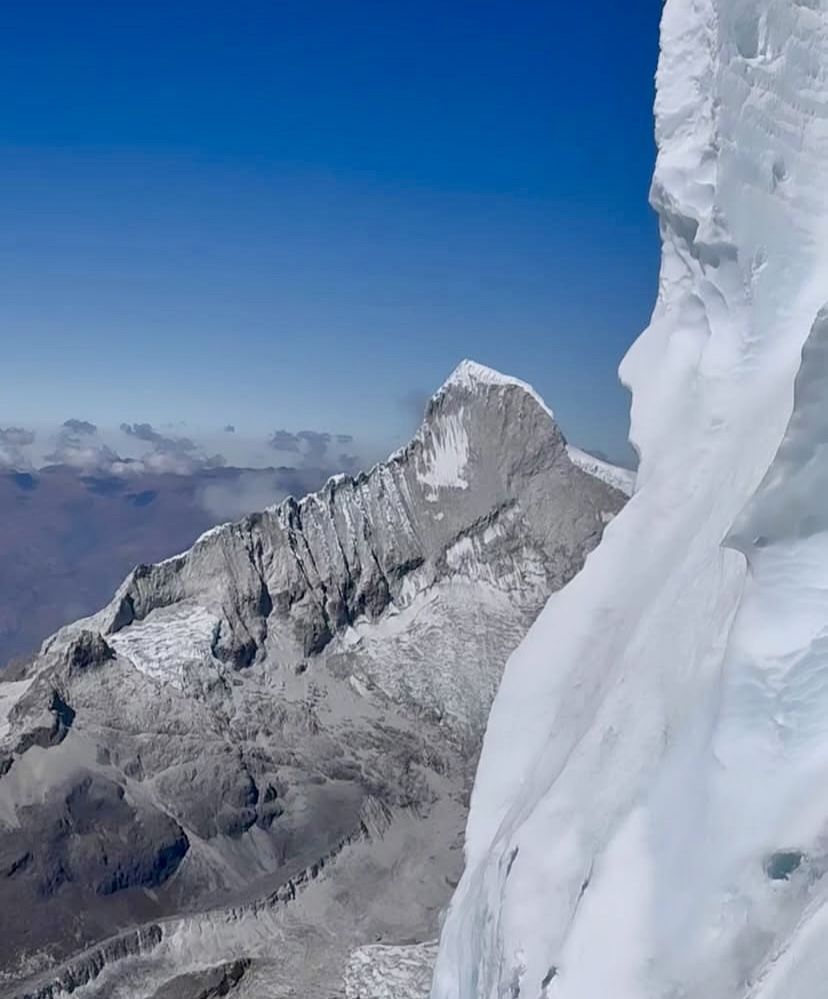
Below the summit, at dawn, Eckland saw a white patch of snow with a woman’s face, which inspired the route’s name. Shumaq Warmi means ‘beautiful woman’ in Quechua. Photo: Josue Sanchez
A suicidal endeavor
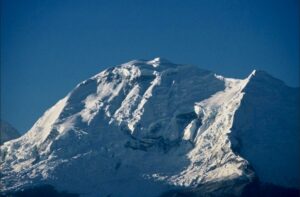
Chacraraju has two distinct summits: 6,108m Chacraraju West, and 6,001m Chacraraju East.
In the 1950s, Chacraraju was widely considered the most difficult unclimbed mountain in the Peruvian Andes. Rival international expeditions scouted its terrifyingly steep, fluted ice walls and giant, unstable summit cornices and declared it impossible to climb with the technology of the time.
American climber John C. Oberlin perfectly described the fearsome reputation of the mountain. In a 1955 scouting report published in The Alpine Journal, Oberlin wrote that conquering Chacraraju’s summit “will apparently require siege or suicide, or perhaps both, if its summit is ever to be reached.”
Those rival teams all chose to retreat rather than face what they saw as a suicidal endeavor.
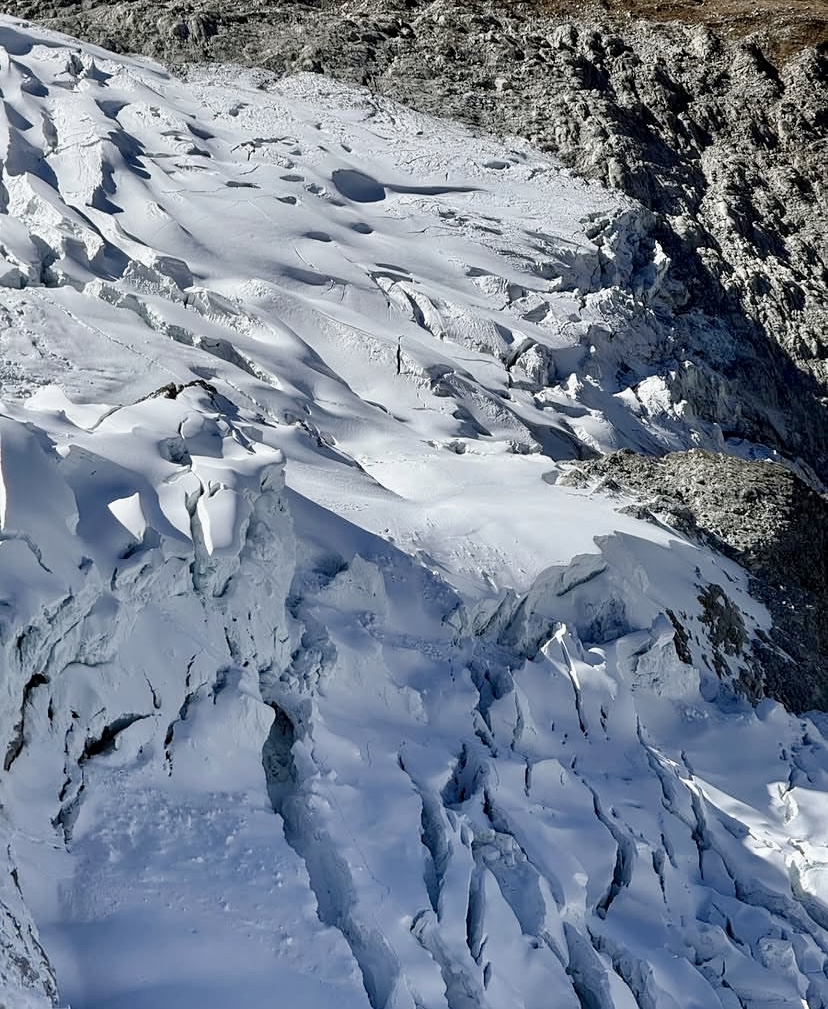
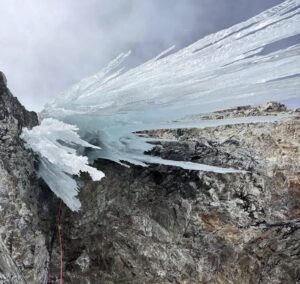
Difficult and dangerous terrain. Photo: Josue Sanchez
First ascents of Chacraraju
The higher west peak was ultimately first climbed on July 31, 1956, by a French expedition led by the legendary Lionel Terray. The summit party consisted of Maurice Davaille, Claude Gaudin, Raymond Jenny, Robert Sennelier, Pierre Souriac, and Terray by the northeast face and northeast ridge. They needed 11 days of grueling, continuous siege tactics just to overcome the final 800 vertical meters.
According to Terray, the ascent of Chacraraju was one of the most arduous and difficult climbs of his entire life. He considered it the hardest and most dangerous peak in the Peruvian Andes.
Chacraraju East was later climbed on August 5, 1962, by Terray, Rene Dubost, Paul Gendre, Guido Magnone, and Jacques Soubis via the northeast ridge and east face. At the time, it marked the very last unclimbed 6,000m summit in the Cordillera Blanca.
Even today, the easiest routes on the mountain are graded ED or ED+ (ED stands for Extremely Difficult). Chacraraju is still widely regarded as the steepest and most difficult 6,000’er in the Andes, and many parties never risk the final cornices to step onto the true summits.
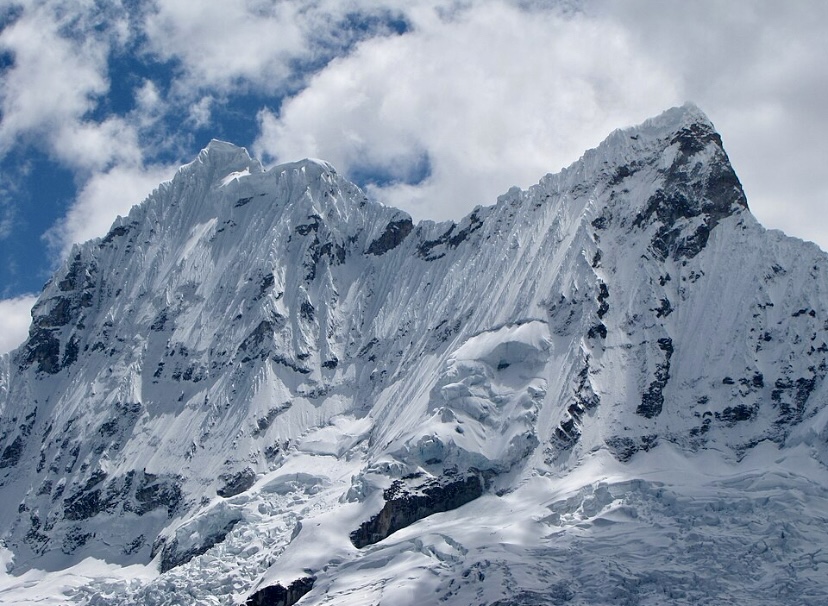
Chacraraju. Photo: Wikipedia