Since our last ocean rowing roundup, journeys across the Atlantic Ocean and Arctic Ocean have come to an end, but two boats are still making their way through difficult conditions in the Indian Ocean.
Arctic Ocean
Team Arctic Row (CH): Roman Mockli, Florian Ramp, Ben von Mitzlaff, and Frederik Jacobs cut short their attempt to cross the Arctic Ocean from Longyearbyen in Svalbard, Norway to the Orkney Islands in Scotland.
Though the weather caused them multiple delays, they started well. The team reached 80.413°N on July 14, setting a new record for the furthest north reached by a human-powered vessel from Svalbard. They then rowed south along the East Greenland Current. On July 29, they reached their halfway point, the island of Jan Mayen. Conditions were tricky, and they were forced onto a paraanchor while waiting for a suitable window to start rowing again. After three and a half days, they were able to continue.
The journey south became increasingly difficult. They battled persistent fog, waves of up to four metres, and sea ice that almost trapped their boat. They fought on, but another unfavourable weather window forced them to shorten their route. Instead of ending in Orkney, Scotland, they diverted to the Faroe Islands, rowing approximately 2,400km of the original 3,100km.
Despite changing their endpoint, the crew is thrilled to have crossed the Arctic Ocean. “We reached the Faroe Islands yesterday, August 5. What a feeling! Our legs are still a bit wobbly, and we need to adjust to land again,” they wrote on social media.
Indian Ocean
Dave ‘Dinger’ Bell (UK): Bell is now well into his crossing of the Indian Ocean, the second ocean of his journey. He has been rowing since November 2025, starting with the Pacific Ocean from Peru to Australia. Without pausing, he passed through the Torres Strait and into the Indian Ocean, and is now aiming for Mauritius. If he completes his route, he will have completed the longest unsupported single-stage row.
After leaving Australia in July, he has seen little sign of human life. However, on July 31, he was jolted awake by his automatic identification system (AIS) alarm in the middle of the night. A huge fishing vessel was 300m away. He used a light to warn the other boat of his position, but they continued toward him. Their approach was intentional; they had spotted his small boat earlier in the day, and when the large swells hit overnight, they wanted to check he was okay.
A few days later, winds hit 30 knots, and a huge wave crashed into Bell’s boat. Water poured through the air vents in the cabin, flooding his bed. His emergency beacon went off, and he contacted the coastguard to put them on standby for a potential rescue. Luckily, conditions calmed relatively quickly, and no rescue was necessary. The next day brought calm water and lots of sunshine so he could dry his mattress out on deck.
After a few weeks of calm conditions, Bell is now facing heavy rain, poor visibility, and swells of around four meters. As always, he is putting his safety first. The moment it looked unsafe, he put on his paraanchor.
“There is no prize for pushing your luck. Sometimes the smartest thing you can do is stop, wait and let the ocean have its moment,” he commented on social media. He has now been sitting on the paraanchor for almost five days, and despite the various podcasts and audiobooks he has downloaded, he is incredibly bored waiting for conditions to improve.
Monkey Fist (UK): Darren Taylor, Glyn Roberts, Lara Vafiadis, and Susannah Cass are rowing 8,200km across the Indian Ocean from Carnarvon, Australia to Mombasa, Kenya. After 41 days at sea, they have covered roughly 4,000km.
At the start of the row, they attempted a southerly route to avoid tricky currents. Yet they haven’t escaped difficult conditions, with unpredictable swells and surface currents from every direction. On the occasional day without high winds and choppy waters, it has been so calm they likened it to rowing through treacle.
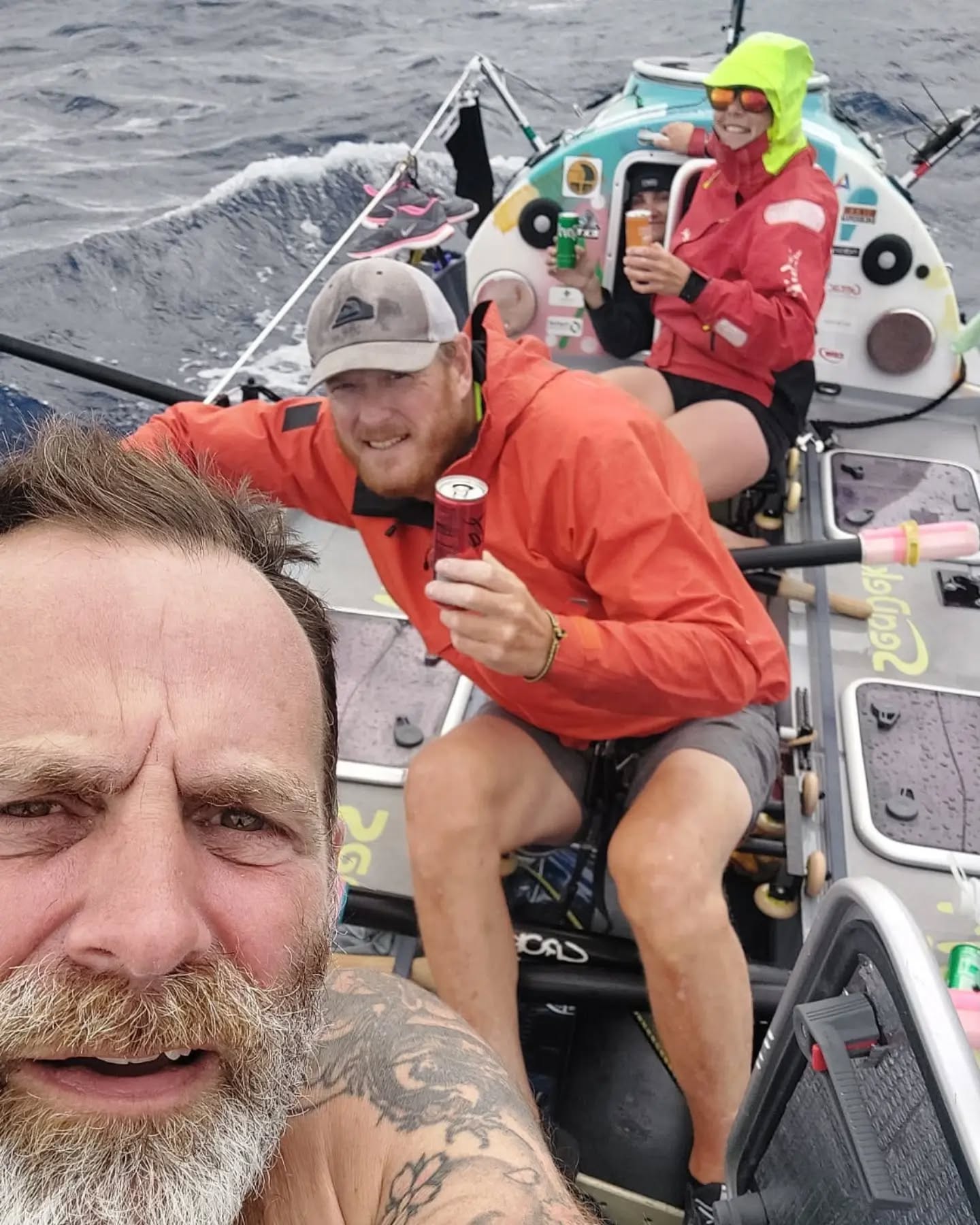
The Monkey Fist crew celebrate reaching 2,000nm (3,704km). Photo: Monkey Fist
They have been forced onto paraanchor multiple times, sometimes for multiple days. This also makes life onboard much more difficult. Sleeping and making food are no longer simple tasks.
On August 18, they hit 2,000 nautical miles (3,704km), which gave everyone a boost. To mark the occasion, they celebrated with cans of Fanta and Sprite. They also hit a small window of good weather, picked up a good current, and were speeding along for 24 hours.
Atlantic Ocean
Min Amy Xu and Ran Li: Min Amy Xu (U.S.) and Ran Li (China) completed their crossing of the North Atlantic after 54 days, three hours, and 52 minutes at sea. They set off at the end of June from St. John’s in Newfoundland, Canada, and rowed to Newlyn, Cornwall, in the UK.
The pair stayed upbeat and made pretty consistent progress. The first month saw them pushing against strong currents and waves. They had to deploy their para anchor 11 times, their autohelm broke, and cloudy weather often rendered their solar panels useless. It became necessary to ration power to keep essential systems running.
Luckily, weather conditions improved as the journey progressed. As they approached the UK, their AIS constantly alerted them to nearby ships. At one point they found themselves surrounded by 30 boats, a huge change from the rest of their row.
Row Aurora: Dawn Smith (UK) and Paul Lore (U.S.) have also been rowing across the North Atlantic from St John’s, Canada to the UK. Their route was very similar to Xu and Li, and they also landed in Newlyn, Cornwall. They made it to the UK on August 15, after 48 days, 7 hours, and 47 minutes.
Though they reached the coastline unaided, they were forced to accept a tow to Newlyn. “We had to row against the tide for six hours and still went backwards before the tide turned. So we rowed solidly. We did not stop for a break,” Smith explained to the BBC.
They believe the harsh conditions were caused by the solar eclipse. “The full moon meant there were really strong spring tides,” she told the Maldon and Burnham Standard. “Locals said they were the strongest tides they’d seen in years. As a professional mariner for 20 years, the last thing you want to do is ask for a tow. But the RNLI agreed it was the sensible thing to do.”
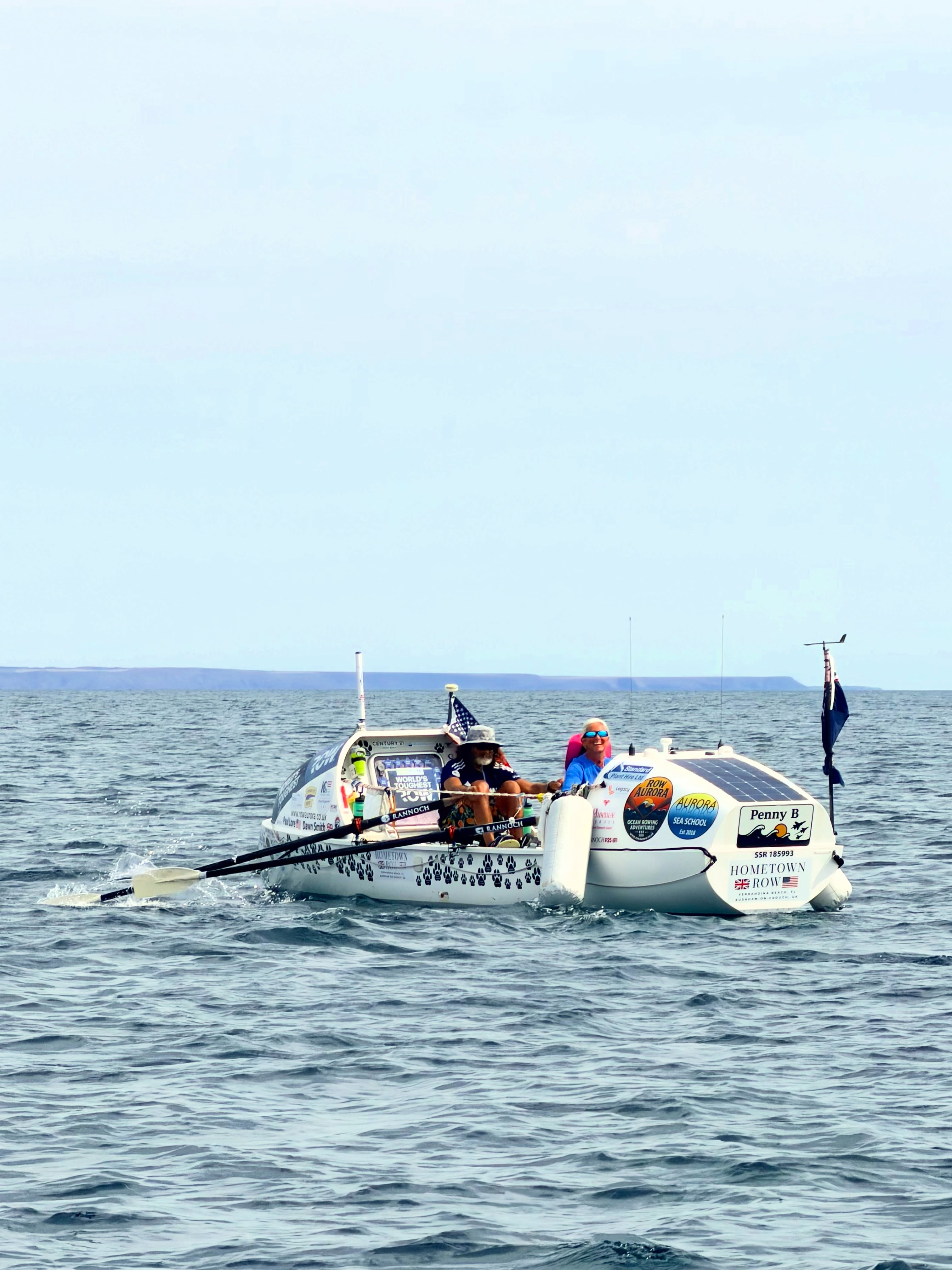
Dawn Smith and Paul Lore reach the UK coastline. Photo: Row Aurora
However, this was not the end of their row. They are rowing along the UK coastline to Smith’s hometown of Burnham on Crouch, which they hope to reach by the end of August.
Earlier this year, the pair completed the World’s Toughest Row event across the Atlantic. They then decided to row back to the UK via Canada. They are the fastest mixed pair to row the North Atlantic from west to east, and Smith now holds the record for the most oceans rowed and greatest total distance rowed by a woman.
Though they received a tow for the final one and a half kilometres coming into the UK, the Ocean Rowing Society, which confirmed these records, told the BBC that the tow was “virtually insignificant” and would not prevent impact the records.