The recent 2026 edition of the Piolets d’Or awards, held last week in a remote corner of the French Alps, felt like an organization trying to adapt to fast-changing times and attract larger audiences while keeping its prestige and spirit intact.
ExplorersWeb was there to meet old acquaintances and to put a face to some of the names we wrote about in the last 12 months. We also wanted to participate in the collective exercise of reflection about the future.
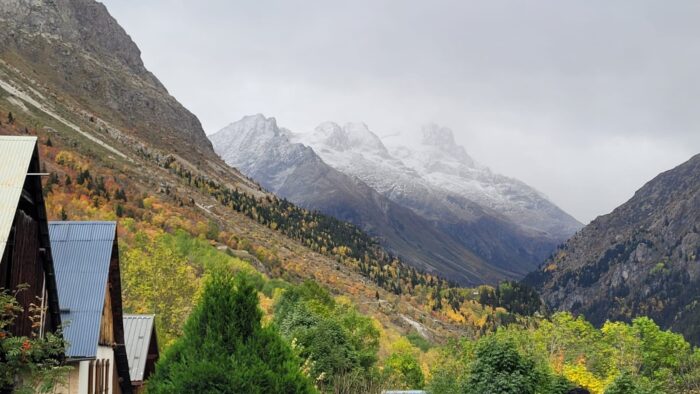
Views of Les Ecrins Massif from Saint-Christophe-en-Oisans. Photo: Angela Benavides
Alpine-style experts debate
Piolet d’Or recipients enjoyed a relaxed atmosphere at the tiny village of Saint-Christophe-en-Oisans and a ceremony at Burg d’Oisans, a 30-minute drive down the valley. Yet, the most interesting event took place the following day, as an elite group of climbers sat around a table in a small hall with large glass windows facing autumn-colored forests and the ragged peaks of the Ecrins Massif, covered in the first snow dust of the season.
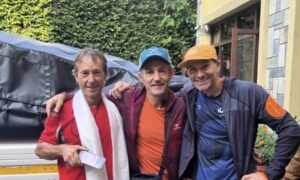
Representing the awardees were Nicolas Jean (awarded for climbing Jannu East with Benjamin Vedrines); the complete teams from Ultar Shar, Aikache Chokk, and Jerupaja Grande; a hyper-energetic, widely smiling Peter Habeler, 84, who received a lifetime achievement Piolet d’Or; Simon Welfringer, who gave a talk; organizers Christian Trommsdorf and David Chambre; geographer and chronicler Rodolphe Popier, and two members of the jury: Jordi Corminas of Spain and Paul Ramsden of the UK. At a press conference, these experts debated some of the hot issues in today’s mountaineering.
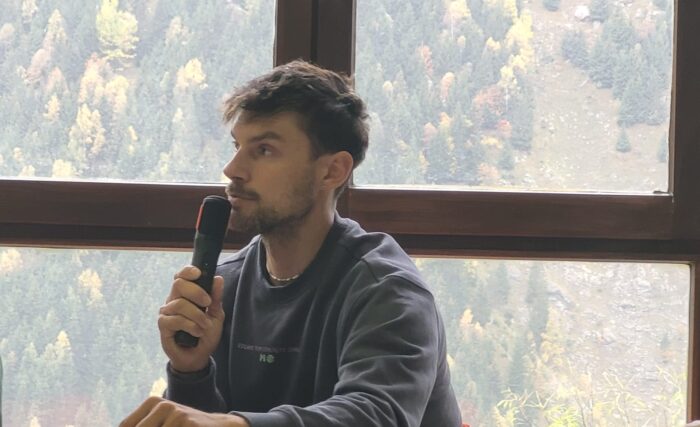
Simon Welfringer of France speaks at the post-Piolets d’Or experts’ panel. Photo: Angela Benavides
How the jury works
Trommsdorf noted that the jury had an easy time selecting the awarded climbs this year. He explained how these expert jurists choose the best alpine-style activities of the year.
The members work remotely, choosing from a Big List of outstanding activities. This list is previously compiled by Lindsay Griffin, long-time editor of the American Alpine Journal, and the UK’s Alpine Club. Jurors study the climbs and narrow it down to a short list of candidates, which is not made public. The awards go to those activities chosen by the majority of jury members. In this case, decisions were finalized on the first vote, with no need for a tie-break.
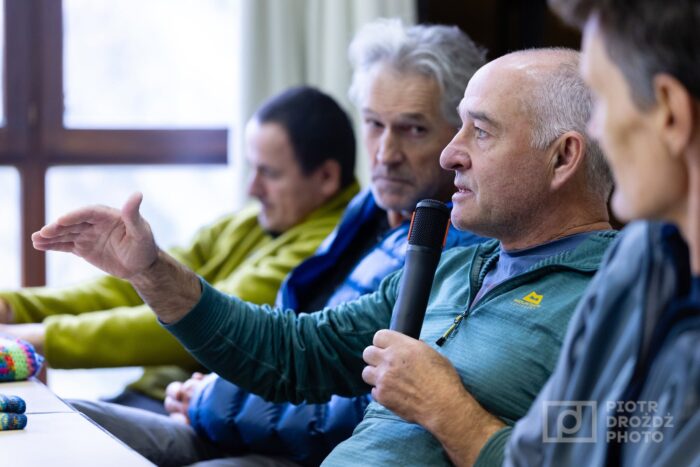
Left to right, Rodolphe Popier, Jordi Corominas, Paul Ramsden (speaking), and David Chambre. Photo: Piotr Drozdz
That led to the first topic of debate: It was noted that some climbing teams happily announce themselves as “Piolet d’Or nominates” on social media when their climbs appear on the Big List — although organizers make it clear that not all activities on that list are suitable for a Piolet d’Or. Yet, no one supported the idea of making the short lists public. The general agreement was to keep the small “best of the year” finalists available only to the jury.
Drones
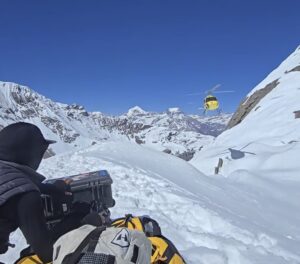
The second topic for debate was the presence of a relatively new piece of technology now ubiquitous on expeditions: drones. These have become essential on rescues, but climbing teams also use them to scout the route ahead. In the near future, drones could also carry supplies, emergency kits, or extra equipment. Commercial outfitters are already using them in this way.
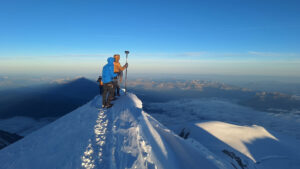
Benjamin Vedrines and Nicolas Jean of France used drones to check the state of their planned route on Jannu. However, they explained that the drone was useless in relaying information about a section that they couldn’t see from Base Camp. It had a different angle of view, and the drone lost connection when it tried to approach that area.
Drones piloted by their base camp film crew also hovered overhead as they traversed the long summit ridge. Finally, before the summit push, they used drones to clearly identify the highest point, to make sure they reached the true summit.
The Ultar Sar team also had a drone, they noted. All the awarded climbers agreed that drones are okay as long as the climbers are completely transparent about what they used them for. Jordi Corominas said the drones are a technological innovation that has come to stay, no different than InReach devices, satphones, or even ice axes and crampons.
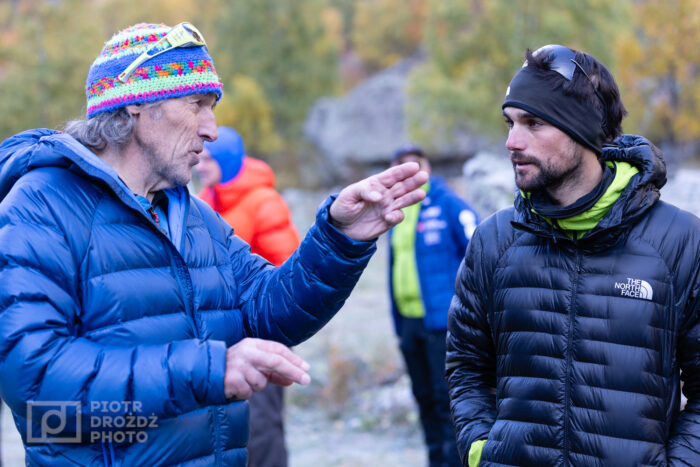
Jordi Corominas, left, discusses past climbs with Benjamin Vedrines. Photo: Piotr Drozdz
Interestingly, one jurist stood against the tide: Paul Ramsden is an advocate for the pure alpine-style criteria of the UK climbing school, and with five Piolets d’Or, he is the overall record holder of these prestigious awards. In his opinion, drones spoil the adventure and uncertainty inherent in pure alpine style. Ramsden himself uses neither drones, trackers, nor even satphones.
Expanded Piolets
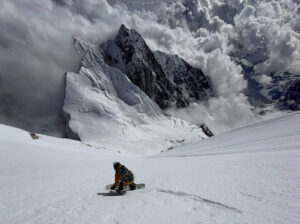
Finally, Trommsdor suggested possibly expanding the awards to create a special Piolet d’Or for the best rock climb and perhaps even the best ski descent. The idea expand on the new performance category introduced this year in the big list as a test. The category featured, among others, the two Everest ski descents in 2025. Both were heavily supported, and Jim Morrison‘s descent of the Hornbein Couloir was oxygen-assisted.
In the end, one of the performance ski descents received the female award: Typhaine Duperier‘s alpine-style climb+ski descent of Nanga Parbat’s Schell route, with Boris Langenstein.
It is unclear whether the new additions will become official in the near future, but some attendees expressed concern about the context in which these take place. Would they award ski expeditions for their boldness or technical excellence without bearing in mind how the skiers reached the start of their descent (supported climbs, fixed routes, even helicopters)?
As for rock climbs: where to set the difference between a rock climb and an alpine climb on high, but dry, faces? The debate was left open. We will find out what, if anything, changes in the next edition of the Piolets d’Or.
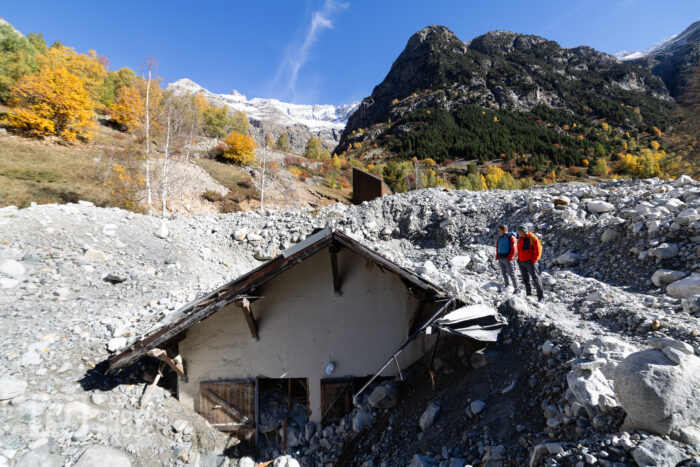
Buried houses at the now abandoned village of La Berarde. Photo: Piotr Drozdz
No more ice axe
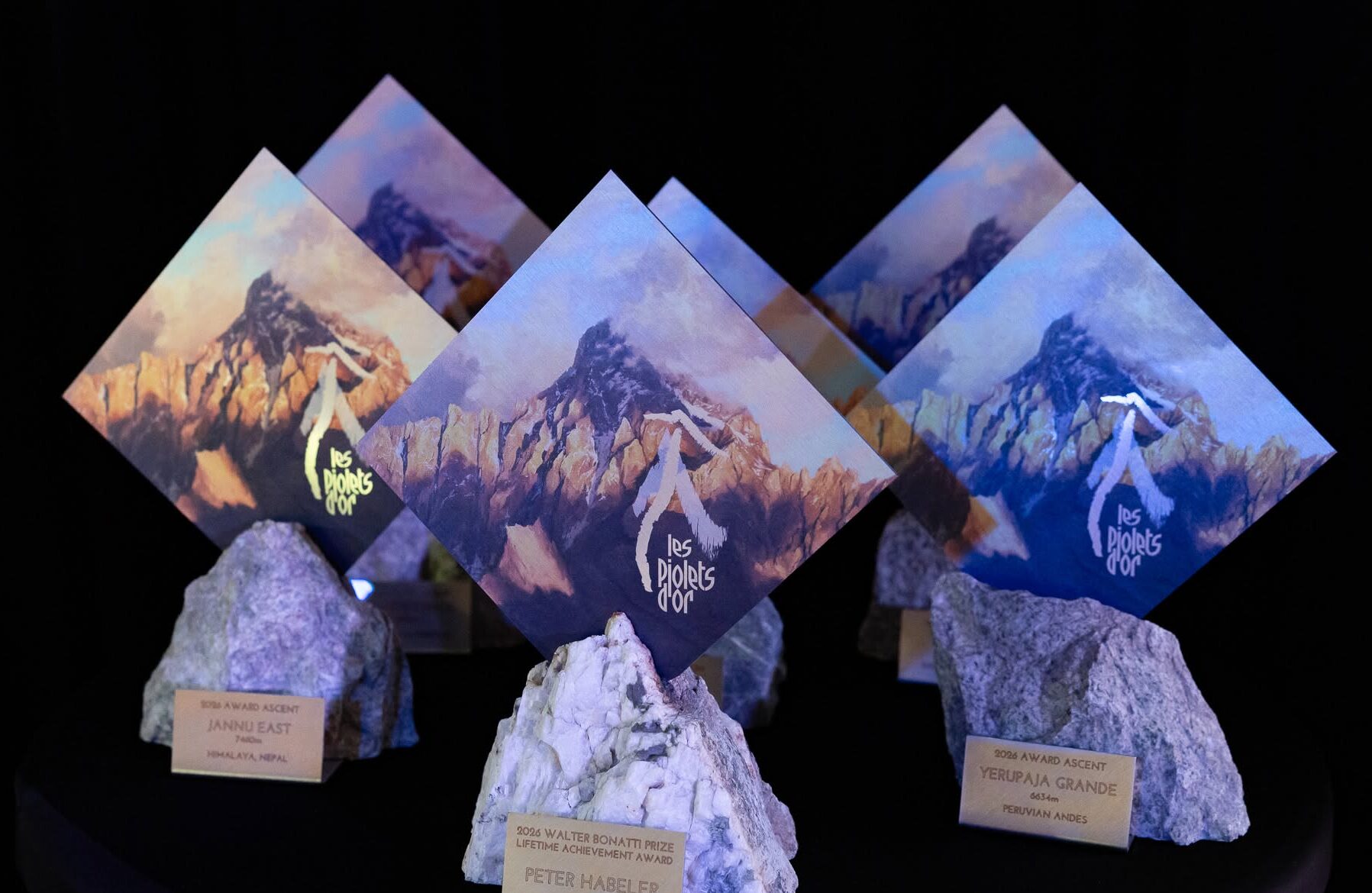
The physical award is no longer an actual piolet (ice axe). In the last few years, it has been a hand-crafted trophy that changes with the venue. This time, it was a plaque with a reproduction of Ecrins National Park’s most distinctive peak, La Meige. It rested on a piece of rock from the remains of La Berarde, a nearby village destroyed in a flood two years ago.
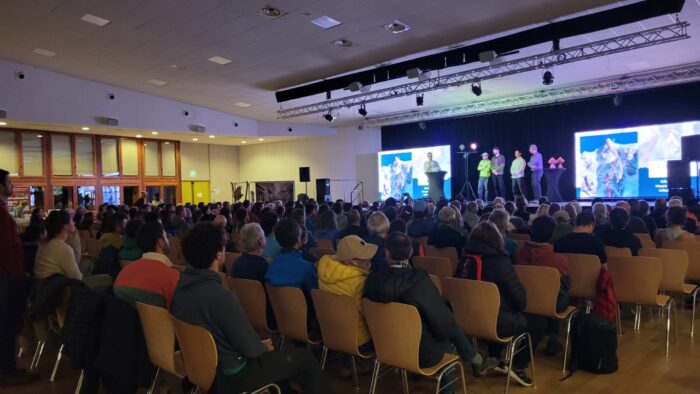
At the Piolets d’Or ceremony in Burg d’Oisans. Photo: Angela Benavides
Next year, the Piolets d’Or will be staged in the same location, perhaps in late summer. The event will commemorate the 150th anniversary of the first ascent of La Meige. The long-term plan is to turn the Piolet d’Or ceremony into a bigger, international mountain festival.