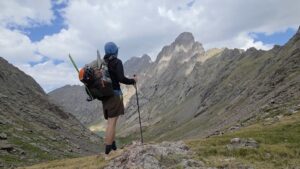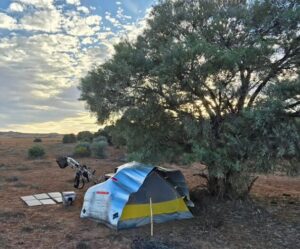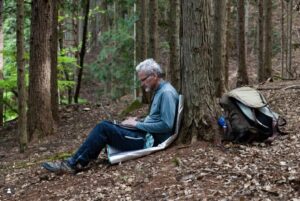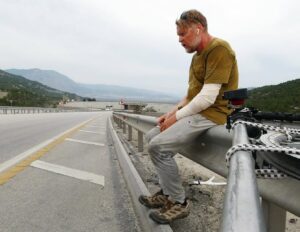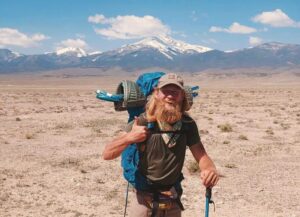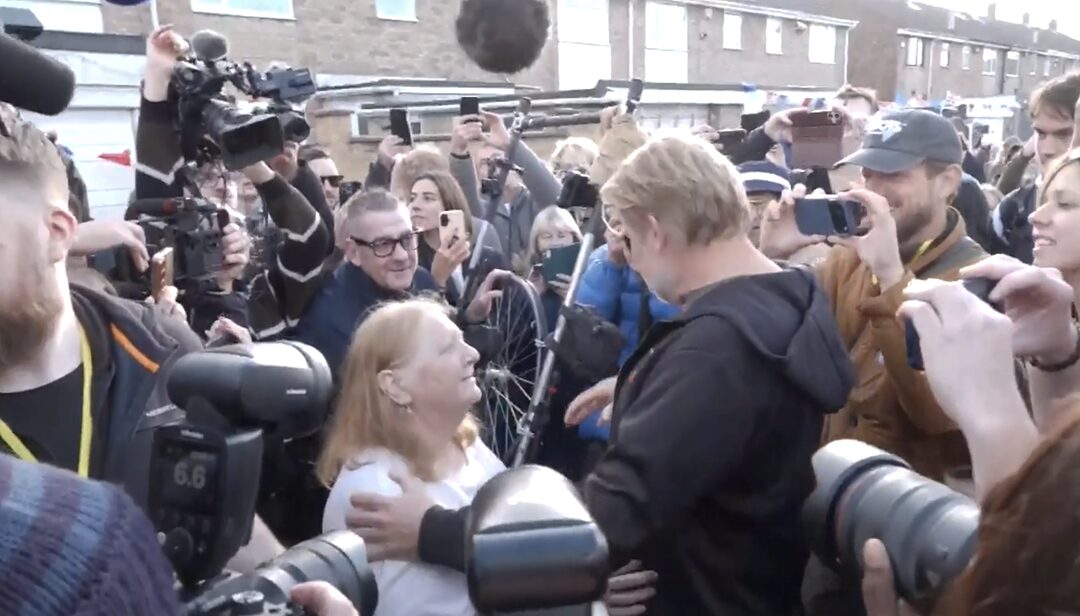
“This is absolute madness,” said a happy Karl Bushby, as hundreds of people welcomed him home in a civic ceremony in his hometown of Hull, England. In a scene that couldn’t be more different from the past 28 years that he has spent walking around the world, Bushby stood underneath a giant Welcome Home Karl sign, made an appreciative speech, then begged off to continue walking the final few steps to his mother’s house, which he left back in 1998.
The reunion with his mother a couple of hours later was equally public, as the pair were surrounded by TV cameras and hundreds of well-wishers.
When Karl Bushby quietly set off from the southern tip of South America on November 1 of that year, it was very different. Bushby was 29 years old. He is now 57. When he began, he had around $500 in his pocket, a two-wheeled cart loaded with supplies, and an idea that most people would have dismissed as a fantasy. He was going to walk home to Hull, England, without using any transport. He would not return to the UK until he could do so on foot. He expected the expedition to take about 12 years. Instead, it has taken 28.
Bushby has spent more than 10,000 days and 50,000km pursuing that single objective. The Goliath Expedition has become one of the longest and most unusual human-powered adventures in modern exploration, and he is nervous about it ending. Speaking to The Washington Post as he approached home, he said: “My purpose and reason for living is about to end. It’s going to be difficult…trying to blend back into a society that you just don’t know anymore.”
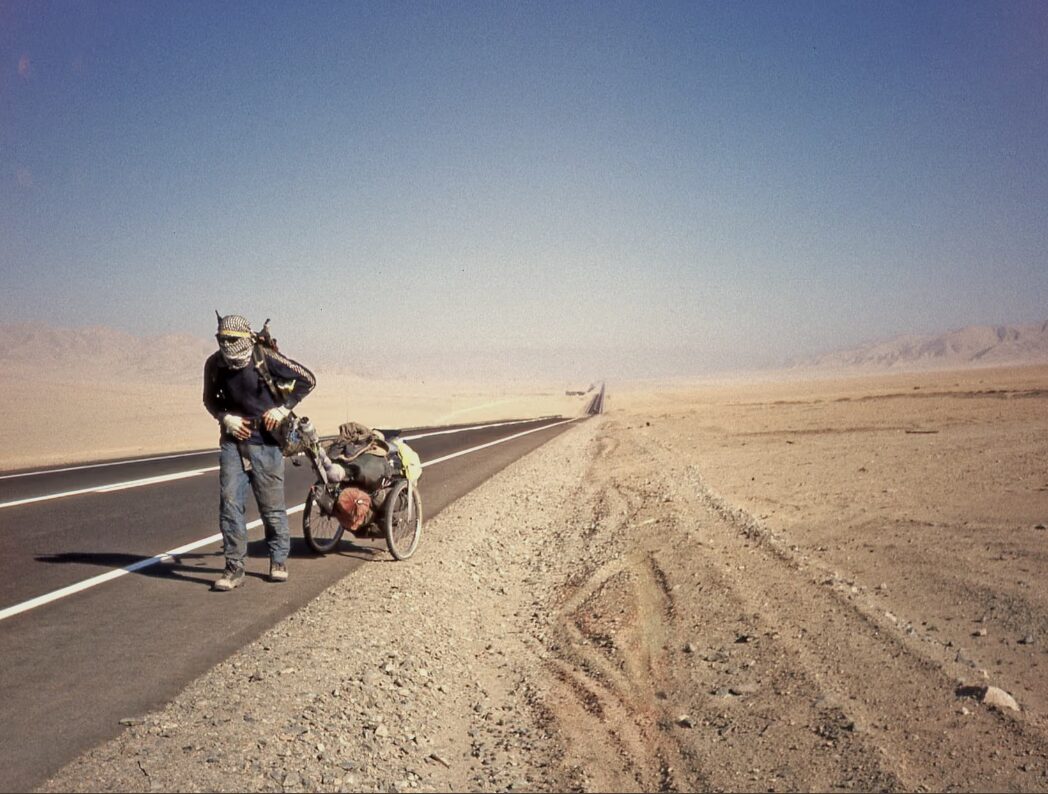
Through Chile’s Atacama Desert. Photo: Karl Bushby
Beginnings
While serving with the Parachute Regiment, Bushby received a birthday card from his father, Keith, who had served in the British Army. In it was a story about special forces soldiers debating whether it was possible to walk from London to New York via the Bering Strait. Looking at a world map, Bushby began tracing the route himself.
But rather than stopping at New York, he extended the line south through the Americas, all the way to the tip of Chile. The result was an expedition that would take him from the southernmost reaches of South America back to his home in England.
“That was the moment the hairs on the back of your neck stand up,” he told GQ Magazine. “You think, well, that’s it.” He did some calculations, created a timeline on the “back of a beer mat,” and estimated the journey would take him 12 years. From that point, Bushby showed nothing but determination. At the start, most people doubted it was even possible. That only made him more certain that he wanted to try.
He gave himself two rules. The first was that he could not use any transportation, even self-propelled vehicles like bicycles or kayaks, to advance the expedition. The second was that he could not return to the UK until he had completed the walk. Those rules sound simple. In practice, they created multiple logistical nightmares and affected almost every aspect of his life.
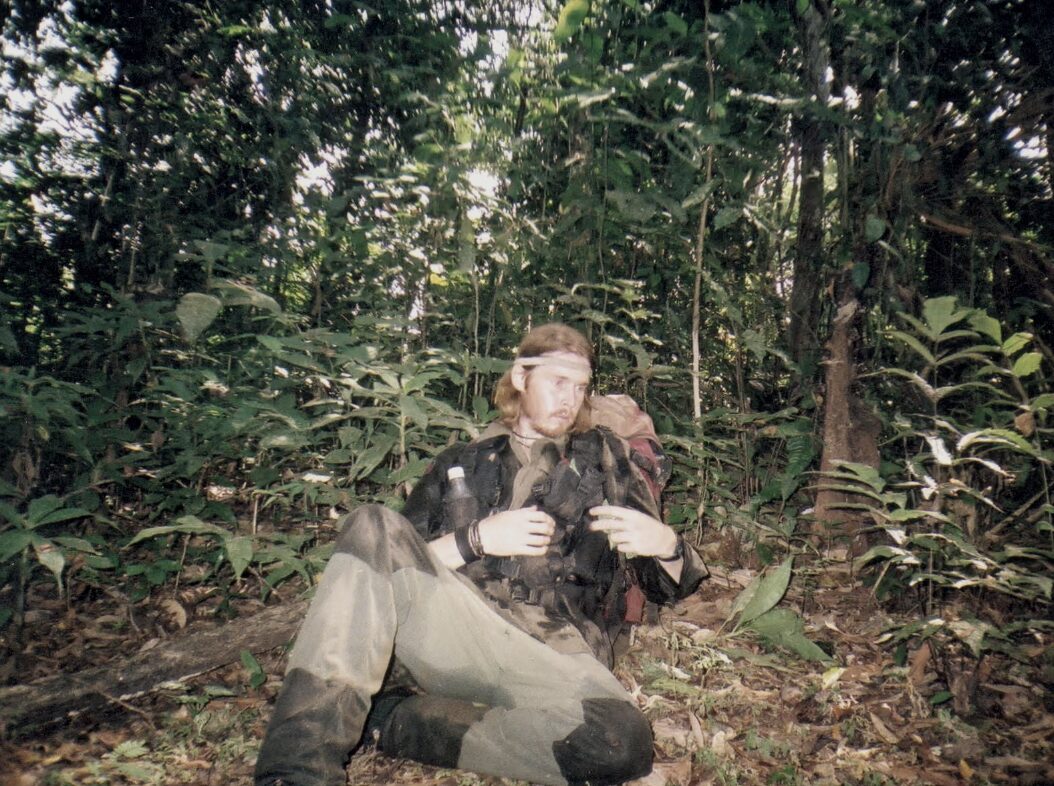
2001, the Darien Gap. Photo: Karl Bushby
Starts in Chile
Bushby left Punta Arenas, Chile, with his equipment loaded onto a cart he calls The Beast. He was not an elite endurance athlete embarking on a carefully funded and organized expedition. He was a young former paratrooper with a few hundred dollars, a rough line on a map, and limited resources. He had no supporters or funding, and relied on gas station food or what locals gave him.
“The first years, you’re living the boys’ adventure dream, and it’s great,” he told The New York Times, “and then it really becomes a grind.”
The first few years took him north through the Americas, including multiple conflict zones. In Peru, he was attacked by a mob; in Colombia, he floated down the crocodile-laden Atrato River to avoid being spotted by armed men. Then he faced the Darien Gap, that infamously dangerous stretch between Colombia and Panama, ruled by drug and human smugglers, that almost all adventurers skirt around.
Eventually, he reached Panama. But emerging from the jungle did not mean he was free to continue. After crossing a restricted border zone without the necessary visa, he was detained for 18 days.
After making his way through the Americas, Bushby eventually finished crossing the U.S., where he had picked up a few sponsorships, and reached Alaska. The next major obstacle, and the one that catapulted his journey into world news, was the Bering Strait, the stretch of water separating North America from Russia.
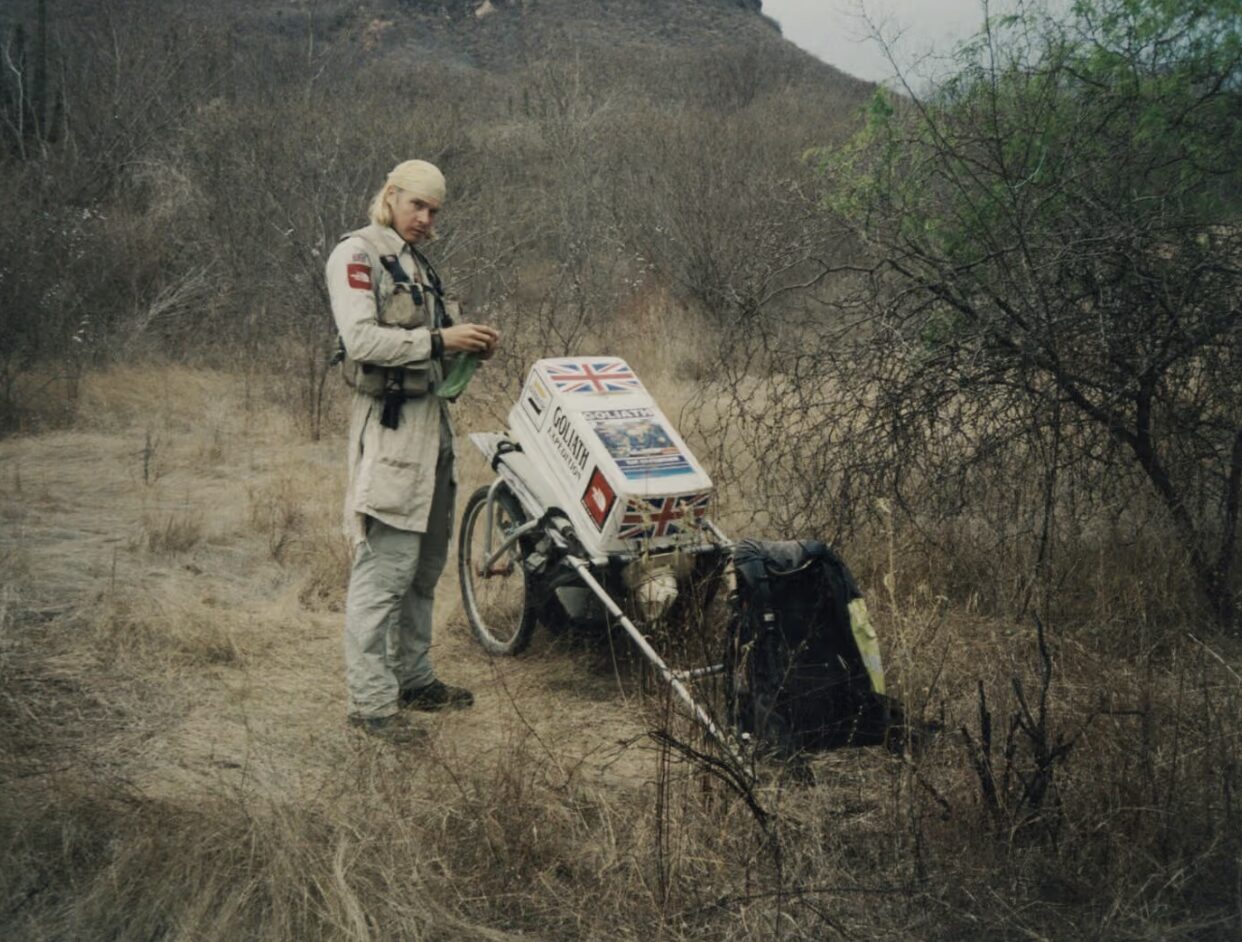
North America. Photo: Karl Bushby
Crosses the Bering Strait
The Arctic had already given Bushby a taste of its dangers. During the Alaskan stage of the expedition, he was rescued by helicopter after becoming stranded on an ice floe that broke away from the coast and drifted out to sea, and had a standoff with a polar bear. He knew how risky the Bering Strait crossing would be.
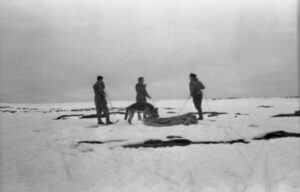
In March 2006, Bushby and French adventurer Dimitri Kieffer spent 14 days crossing the Bering Strait between Alaska and Russia on foot. With 90kg sleds, they traveled across the shifting ice in temperatures that fell to around -30˚C, against the prevailing winds as the ice moved beneath them.
Wearing dry suits, they had to swim at points through the icy, slushy water. “All night long, you’re just listening to the grinding, and the ice is just like screaming,” he told The New York Times. “We actually had to evacuate the tent during the night because the thing started to break apart beneath us.”
They made it across, achieving a rare crossing of one of the world’s most formidable natural barriers. But reaching Russia did not mean the difficulties were over. Russian authorities detained the pair for entering the country without the required permission. They faced the possibility of deportation.
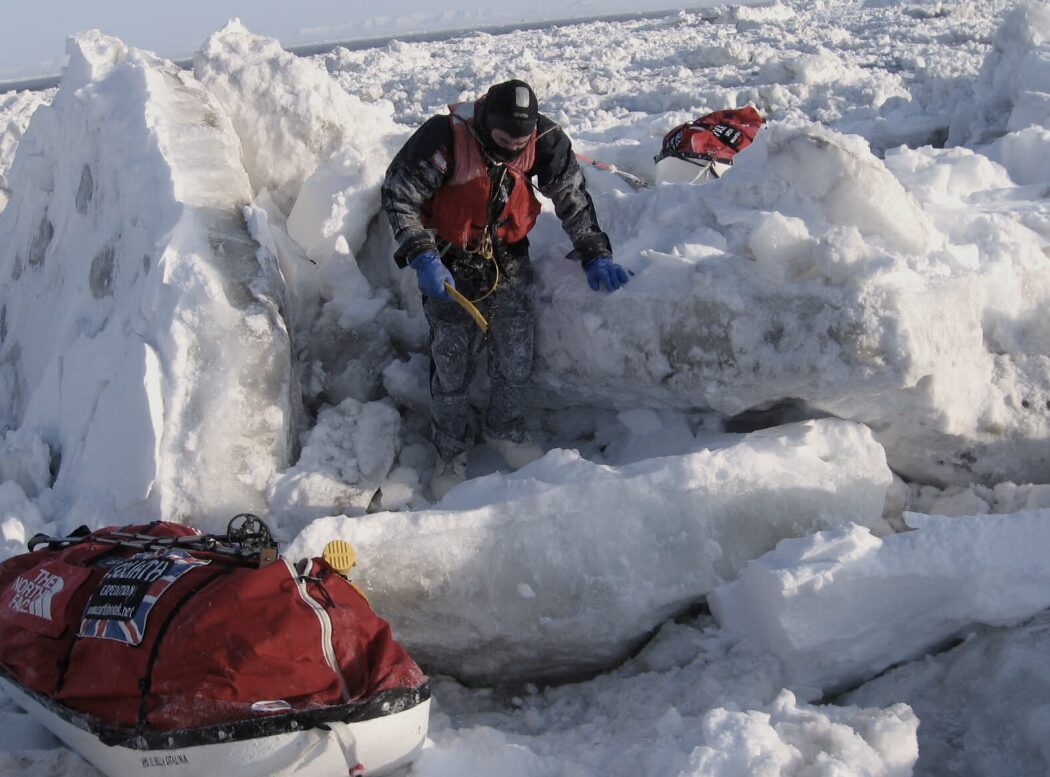
Crossing the Bering Strait. Photo: Karl Bushby
Dealing with Russia
Russia would consume years of Bushby’s life. He had to leave the country every 90 days because his tourist visa allowed him to stay in Russia for only 90 of every 180 days. Then in 2008, his journey came to a standstill. He lost sponsorship and could not travel to Russia for a few years. In 2011, he resumed his trek, again in 90-day stints. Then in 2012, he was denied a further visa, and in 2013, he received a five-year entry ban from Russia.
Here, Bushby responded with an extraordinary protest. He walked approximately 5,000km from Los Angeles to the Russian Embassy in Washington, D.C., hoping to draw attention to his predicament and secure the paperwork he needed to continue.
The years of delay exposed another unusual aspect of the expedition. Bushby’s rules did not mean he had to remain indefinitely in the country where he was stuck. Nor did they prevent him from using transport for journeys unrelated to advancing his route home. However, he couldn’t fly back to the UK during these hiatuses.
When visas, funding, or political restrictions prevented him from continuing, he could fly elsewhere, take a break, and wait until circumstances allowed him to resume. But he could not use that flight to skip a section of the route. Whenever he returned, he had to pick up from the exact point where he had stopped. Most of the time, he decamped to Mexico. Its lower cost of living made it a practical place to wait. He also spent time in the United States.
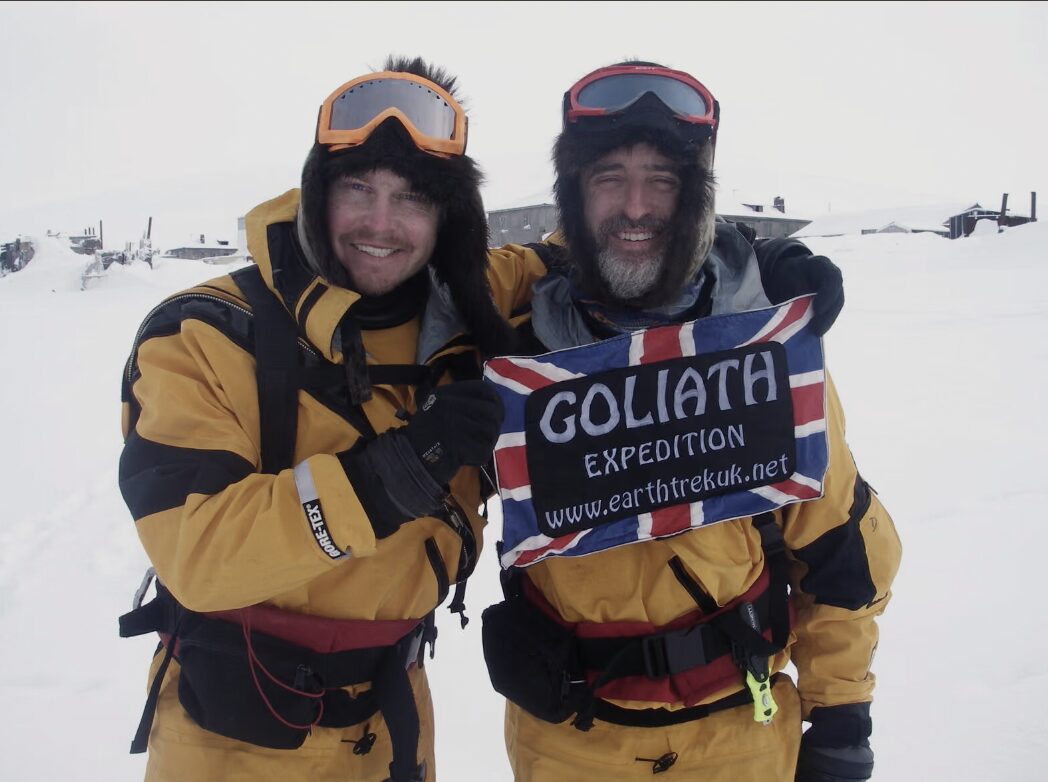
Bushby and Dimitri Kieffer, 2006. Photo: Karl Bushby
Self-imposed restrictions
The distinction mattered enormously to the expedition. Bushby could board a plane to escape a logistical dead end, but when he returned to the route, he had to pick up where he had stopped. He could not simply fly over the awkward section and resume walking on the other side.
The arrangement might seem to stretch the definition of walking around the world. But for Bushby, it was the only way to maintain his two original rules without spending years of his life waiting at a closed border. Some visa delays took years to resolve. And the longer the journey continued, the harder it became to predict when, or even whether, it would end. Getting across Russia alone took almost 10 years.
The passage of time is one of the most striking aspects of Bushby’s story. His expedition began in an era before smartphones, Instagram, and the expectation of sharing every stage of an adventure online. The young man who left Chile in 1998 could never have imagined that nearly three decades later, people around the world would be following his progress toward his childhood home. The fact that so many people are following it still baffles Bushby.
While Bushby was away, life continued for the people he had left behind. His son, Adam, grew up, and his family had to get on with their lives without him. Adam was eight when he set off. He is now 36, with a family of his own, including a 12-year-old daughter whom Bushby has never met.
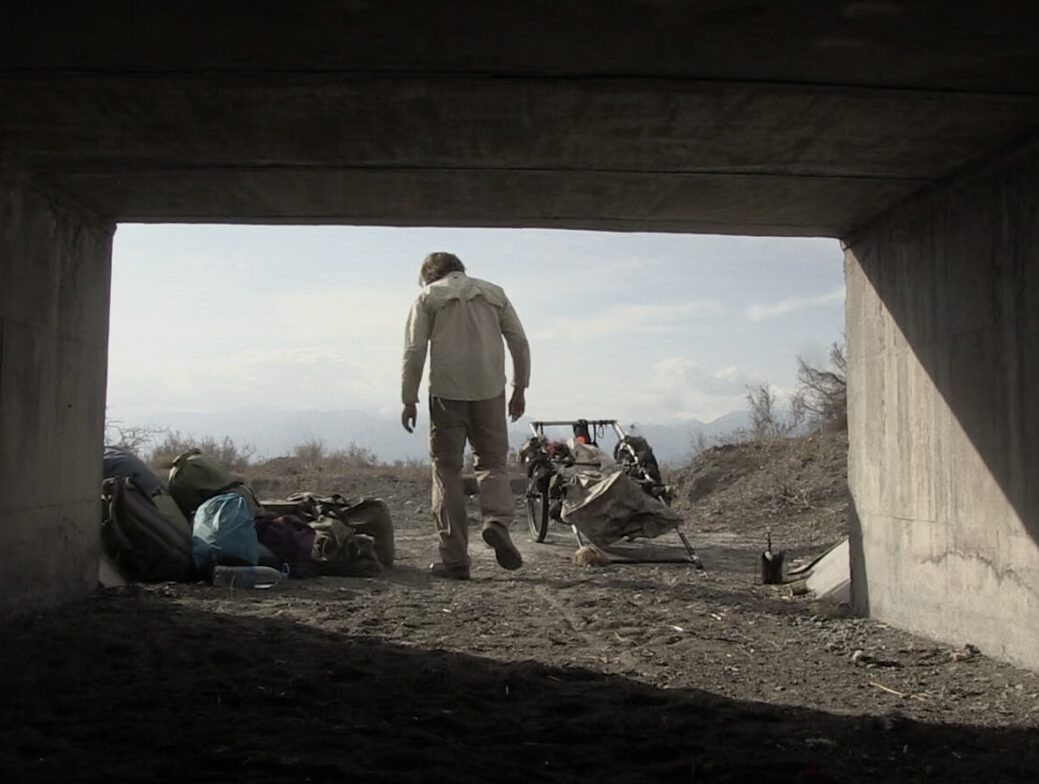
Photo: Karl Bushby
Bushby’s son
When his dad started the walk, Adam didn’t fully understand what was going on, or know how to explain it to people who asked. Over the years, they have tried to stay in touch and maintain some kind of relationship. At 14, Adam flew to Alaska to see his dad. It was six years after the expedition began and a turning point for him in accepting what Bushby was doing. “I did feel a bit awkward because at that point I didn’t really know my dad,” he told GQ Magazine.
They later spent 10 days walking together as part of a National Geographic documentary project. Adam described the experience as surreal, suddenly stepping into his father’s world. They have spoken regularly since, but as Adam put it: “[His] life went this way, and I went that way, two separate routes.”
In various interviews, Adam has explained that he had nothing against his father’s ambition, that he respects what he has done and is very proud of him. But also that growing up without him had been difficult.
Karl Bushby has not seen other members of his family for years. He met Adam when he stepped out of the water after crossing the English Channel back to England, but he has not seen his mother in over a decade, even though he will be living with her once he arrives back at his childhood home. He recognizes how difficult the situation will be and that it is due to his choices over the last 30 years.
“The relationship between me and my son is good, but there’s a lot to resolve there,” he told GQ Magazine. “I’ve got a granddaughter I’ve never seen, and then dear old mother, Lord. I have to live with my mother now. I’m going from a global adventure to living with my mother in a basement at 57. This is going to be a challenge.”
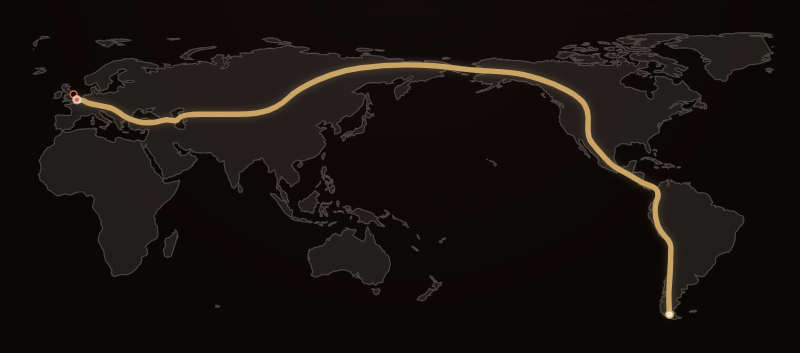
The route. Image: Karl Bushby
Lonely life
Life on the road has often been lonely, but Bushby has seen kindness and hospitality in every corner of the globe. “I’ve been welcomed in by the poorest of the poor,” he told The Washington Post. “I’ve met 99.9999% of the very best of humanity. Every culture, every country, has been the same response.”
He has also had two significant romantic relationships during the expedition. He spent around seven years with a Colombian woman. Later, he had a three-year relationship with a woman from Japan. He met both while on the expedition, and it was also the reason both broke down.
After finally getting across Russia, Bushby continued through Mongolia, where he joined with other adventurers, including Angela Maxwell, to trek across the Gobi Desert with camels. After 1,130km and several disagreements, the group went their separate ways, and Busby continued into China by himself. In 2018, he crossed Kazakhstan and then made his way through Uzbekistan and Turkmenistan. Once again, visa issues ground the journey to a standstill. He could not get into Iran.
At the same time, the world was struck down by the pandemic. More years of waiting in Mexico began, even though Bushby still had a substantial distance to cover. Eventually, in 2022, he was on the move again. Once again joined by Angela Maxwell, he did something he had never intended doing during the expedition — swimming across the Caspian Sea.
Iran: the biggest problem
Visa issues and geopolitics meant he was unable to cross into Iran. So he came up with a new plan. He and Maxwell went back to Uzbekistan and took a different route. They walked across the Kyzylkum Desert until they reached the Caspian Sea. A self-proclaimed terrible swimmer, he was completely outside of his comfort zone. Wearing a wetsuit and flotation equipment, he described his floating-and-swimming hybrid as floatimming. It might not have been the most elegant crossing, but after 32 days at sea, 27 of which he was swimming with Maxwell and two Azerbaijani swimmers in very choppy waters, he completed the 288km swim.
Back on solid ground, his next job was to get across Azerbaijan and into Turkey. Here, he hit a huge milestone. He crossed the Bosphorus Bridge on May 2, 2025. This meant he was back in Europe for the first time since he started walking.
The remaining distance to Britain was comparatively short, but the final stages were not straightforward. Once again, visa restrictions were the thorn in his side. Limited to traveling for 90 days at a time before having to leave Europe, he continued to use Mexico as a base as he waited for his 90 days to reset and tackled the remaining distance in short stretches.
He made it through Turkey, Bulgaria, and Romania before confronting the next issue. Bushby always knew one of the logistical challenges would be getting from France to England. He started trying to pull a plan together. Unsurprisingly, for someone who has walked across the world, his goal was to cross it via the Channel Tunnel. The issue was that this was forbidden. He had hoped to use their service tunnel, but his request was denied.
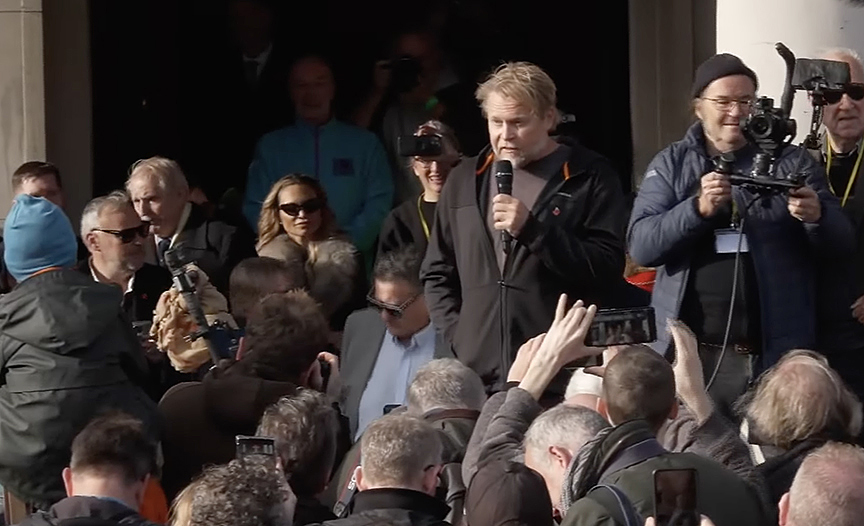
Karl Bushby speaks at a civic ceremony in Hull, England earlier today. Photo: YouTube
Final hurdle: the Channel
As he continued walking through Hungary and Austria, he attempted to appeal the decision, reaching out to anyone who might help, to no avail. “We have carefully considered his request and explored a range of possible options. In this instance, regretfully, we are unable to accommodate Mr Bushby’s wishes,” a spokesperson for the Eurotunnel told the BBC. This meant the only alternative was to get back into the water and swim the Channel.
Still walking, he had made it to Germany. Then he picked his way across Belgium and France, all the while decamping to Mexico, Canada, or the U.S. every 90 days, and trying to piece together a plan for swimming the Channel. This proved to be another headache regarding permissions.
French rules stop anyone swimming the Channel from France to Britain. He thought he had been granted an exemption, but in September, he learned that was not the case. After much negotiation, he finally got the go-ahead. On October 5, Bushby finally landed back on British soil at Shakespeare Beach near Dover after swimming the English Channel.
The crossing took three days. He spent around 20 hours in the water, spent the nights on a safety vessel, and dropped back into the water at his last-known position each morning.
Fear of the future
After 28 years abroad, he was finally back in the country he had left in 1998. But rather than feeling joy, he told The New York Times he felt a real sense of loss. After three decades on the road, the prospect of just 400km to go was hugely daunting. “I’m about to lose my purpose for living,” he said. “It’s about to abruptly end.”
He is nervous about what comes next and reintegrating into a society he no longer knows. He is considering retraining as a teacher, as he loved giving talks in schools as he walked.
One big question is why Bushby has become so celebrated. He is not the first person to have attempted a long-distance walk around the world. Other adventurers have spent years traveling between countries, crossing continents on foot, or undertaking journeys without motorized transport, but Bushby has singularly captured the world’s attention.

Karl Bushby, back turned, leaves the civic ceremony to walk the last few steps to his mother’s house. Photo: YouTube
It might be the particular combination of his rules, or the fact that his objective is immediately understandable. He left home, and he is walking back. There is no complicated scientific mission to explain, no specialized equipment that the public needs to understand, and no obscure record category he is aiming for. The simplicity of it gives the story an almost fable-like quality, even though the journey was not simple at all.
Touched a chord
With just two rules, the expedition is relatively easy to follow. Every delay matters because Bushby cannot simply skip ahead. He is forced to wait or find another solution when something blocks his route. The question becomes how he will get around it without abandoning his principles.
Then there is the sheer amount of time it has taken. People who first encountered Bushby’s expedition in their twenties are now well into middle age themselves. Initially, there were no updates on social media. Instead, there was the odd news article that cropped up every few years about the same man, still walking across the world. A story that seemed like an ambitious adventure morphed into an entire adult life on the road.
Bushby has not necessarily made the journey look enjoyable. His progress has depended as much, if not more, on navigating bureaucracy and finding support as on putting one foot in front of the other. Despite it all, he continued.
As the journey has hit an era where we can follow an adventurer’s progress in real time, every obstacle and milestone has renewed interest in the question that has followed Bushby for 28 years: Will he actually make it home?
Now that he has to confront a new question: How do you cope with coming home after three decades? “I will have to figure out who I am again. What is the meaning to it all? How do I find that meaning and purpose? How do I fill that hole I’m suddenly going to find myself in?” he told the BBC in the days before the expected end of the expedition. “I think the old adage goes…the only thing worse than a man who can’t fulfill his dreams is a man who’s fulfilled his dreams…because then what?”