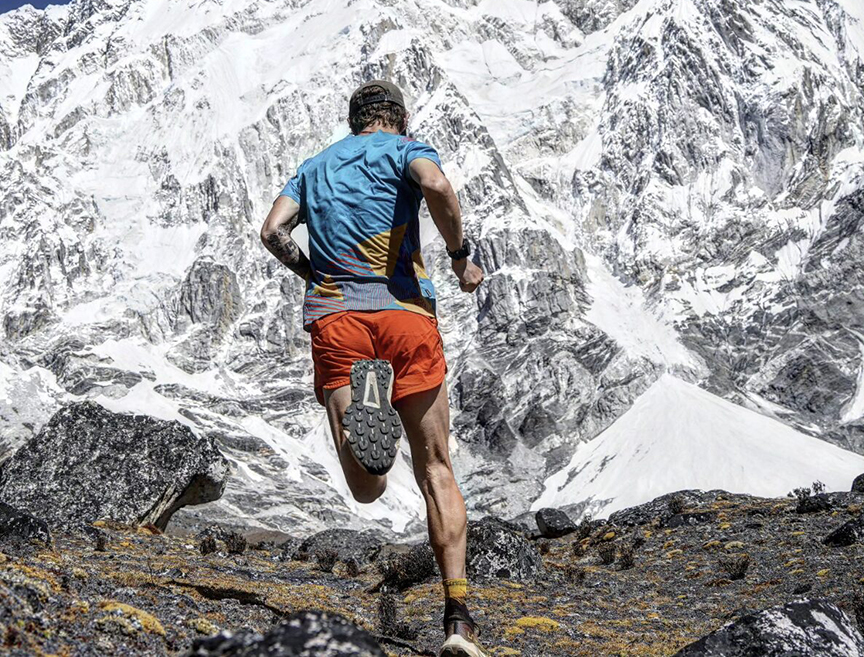
The attempt last week to break the speed record on Everest by American trail runner Tyler Andrews created confusion and debate. It may have also crossed some red lines that might invalidate the record, if not on the books, at least among the mountaineering community.
At the same time — refreshingly, compared to most Everest personalities — Andrews has openly replied to our questions, even the controversial ones. His answers give a clearer picture of the grey areas in commercial high-altitude climbing. In fact, Andrews’ testimony may change how we look at other Everest-related records and achievements.
Here are his comments about his recent attempt, his upcoming redo, and the use of oxygen…and helicopters.
Resorting to oxygen
“I put on oxygen after Camp 2, as the forecast for the summit looked like the winds would be too strong for a no-gas climb,” Andrews says.
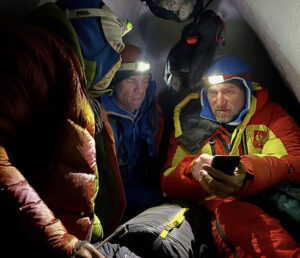
He said he reached Camp 4 at a good pace and was feeling great, despite the high winds. At Camp 4, Andrews had some trouble communicating with the Sherpas who were there as support. As a result, “what was supposed to be a 10-15 minute stop turned into almost an hour before I set off again, which made my comfortable margin on the record much narrower.”
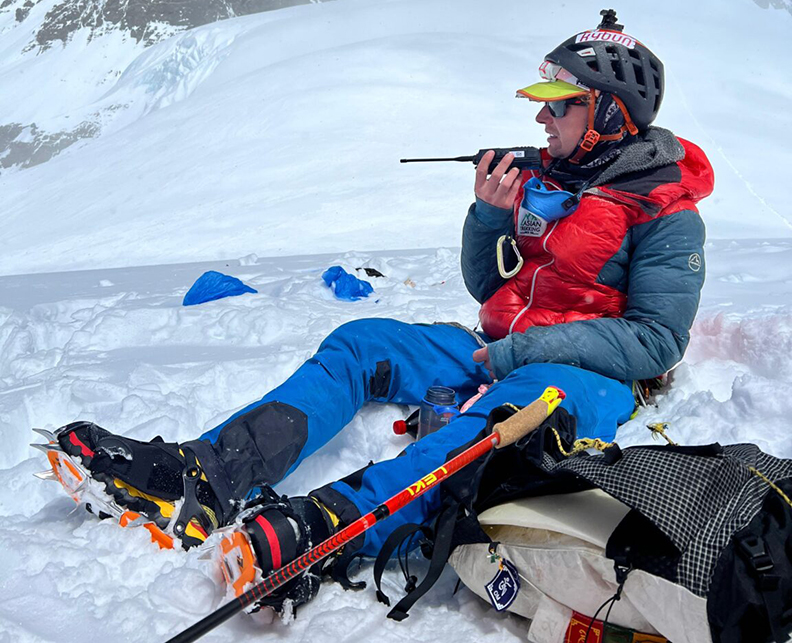
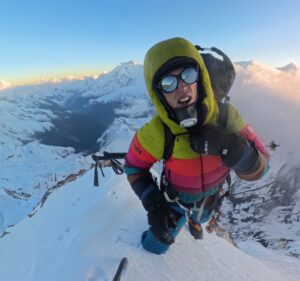
Andrews at Everest’s South Col during a previous attempt. Photo: Tyler Andrews
Further up, it was his support team who decided to call off their own climb. In Andrews’ own words:
From there, I continued to move well around 400-500m+/hour up to the Balcony (which would have put me on the summit well under [the] 10h56 gas record).
At that point, I looked behind me and realized that the team member who was supposed to follow behind for safety and who would be carrying an extra O2 cylinder for the descent was not coming. They had said it was too windy to go to the summit, and it appeared they were sticking to that.
“I continued on another 100m or so up the hill, but was doing some mental math and realized I would be hitting the summit right as I would run out of gas, [on] a majorly cold and windy day, and with no one else on the mountain,” Andrews said. He considered the risk of frostbite too high and headed back down.
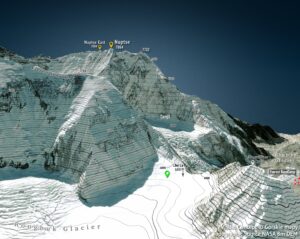
Tyler Andrews’ trip is registered and available on Strava (check it here). His track shows the ascent, the highest point reached, and the descent, until Camp 2.
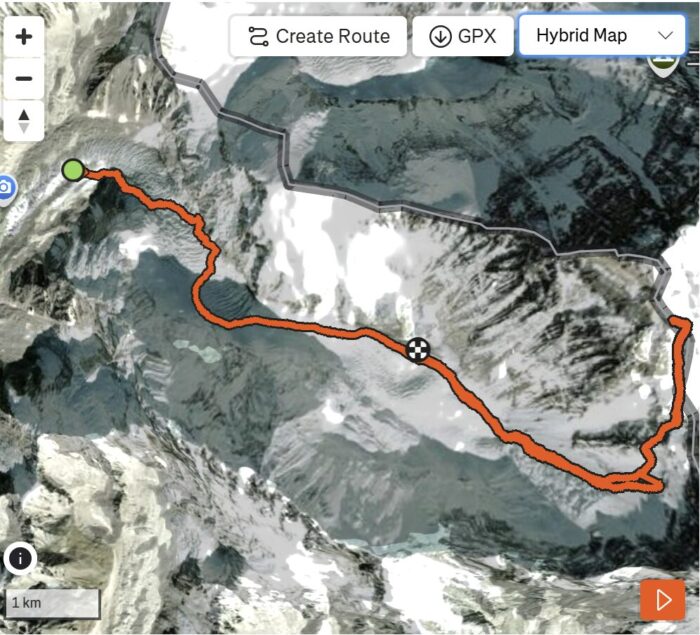
Tyler Andrews’ Everest FKT attempt on May 22-23 on Strava.
Two days later, while the debate about his use of oxygen grew, an ExplorersWeb reader and mountaineer from Japan commented to this writer on social media.
“Andrews’ Inreach shows a difference of just 10 minutes between Camp 2 and Base Camp,” he said. “Could you ask him if he caught a helicopter from Camp 2 down?”
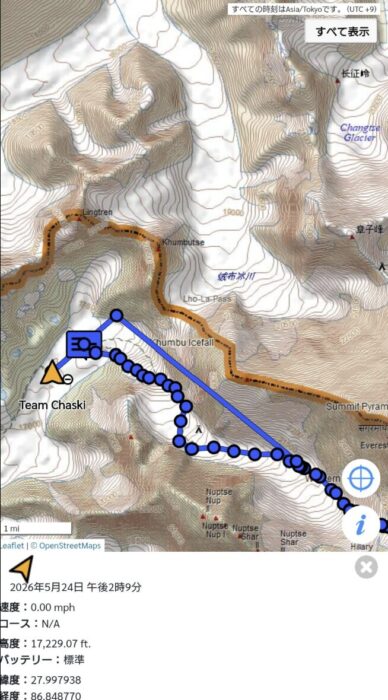
Screenshot of Andrews’ descent track by a Japanese reader.
Airlift under medical advice
We asked Andrews, and here is his reply.
“Yes, I was having some issues with my vision on the descent down the Lhotse Face, and so I called my team’s physician from C3…He recommended I [fly] down and not take any risks in the ice fall in case it was snowblindness or corneal abrasion from the high wind and snow/dust particles, as those could get worse and then I would be stranded and alone in the ice fall in the middle of the day.” Andrews wrote, noting he only put on his goggles on at the Balcony, “which was probably a mistake, even though it was not that bright yet.” (He was traveling mostly during the night.)
Andrews said he saw the doctor at Base Camp, received some medicine, and now feels fine.
“I didn’t publicly share this because I know there’s a lot of taboo and armchair critics about flights above EBC and what constitutes a rescue, but I’m grateful I could get down and get treated ASAP so I could recover well enough to head back up the hill,” he explained.
The meaning of using oxygen
Andrews’ decision to use oxygen mid-climb during his recent attempt to set the fastest known time on Everest has posed a dilemma for statisticians and prompted responses from respected figures such as Kilian Jornet.

Kilian Jornet has sped up Everest twice and has also attempted the Everest-Lhotse traverse. Photo: Kilian Jornet/Instagram
“The difficulty of an ascent without oxygen is twofold: physiological and, equally important, related to exposure,” Jornet commented after a piece on the issue we published yesterday. “Having access to oxygen, even if not used, eliminates this risk… In my opinion, if oxygen is available on the expedition, it cannot be considered a purely oxygen-free climb.”
Likewise, asked by ExplorersWeb, the team at The Himalayan Database noted how the case of a speed climber considering an Everest climb with and without oxygen in the same season is unprecedented and might require new categories or sections in their files.
Coherence
Ryan Mitchell of the US, who used oxygen at Base Camp due to a medical emergency, would have had a subsequent no-O2 Everest climb (which he planned to attempt) invalidated.
At the same time as Andrews recovers in preparation for another FKT attempt, Kristin Harila of Norway is heading to the summit of Everest. Originally, Harila intended to complete the Nuptse-Lhotse-Everest climbs without bottled oxygen. However, she used supplemental O2 on Lhotse. The question is whether, if she summits Everest without oxygen tomorrow, it would be a valid no-O2 climb.
Indeed, Everest is a different mountain from Lhotse, and the Norwegian athlete did retreat all the way down to Base Camp after summiting Lhotse. However, from another point of view, she has taken on a triple challenge, and if she had not used oxygen on Lhotse, she might not have recovered in time to attempt Everest so soon afterward.
Harila’s case brings another factor to the equation: coherence. Concerning Jornet’s comment: Having O2 available, even if it isn’t used, provides huge psychological support, because if things go south, the climber can reach for it. One can argue that a no-O2 climber shouldn’t have the option to change their mind and switch to gas mid-climb, as Andrews and Harila did. The option should be to continue the climb or abort it.
For Andrews, however, oxygen is a logical backup, and having a Sherpa behind him to carry it is also fair game. In an FKT, there is a “supported” category that considers such help as acceptable (check FKT guidelines here). But climbing Everest is — or it is supposed to be — about mountaineering as well as athletics. It has its own ethics based on its climbing history.
Ghost helicopters
As for helicopters flying to and from Camp 2 on Everest, it’s about time to openly admit they are used regularly to carry equipment, Sherpa staff, sick climbers and, sometimes, ordinary climbers willing to pay to skip the Khumbu Icefall on the way down. Nepal’s government regulations forbid their use by the public except in medical emergencies, but it is hard to define what constitutes an “emergency” when applied to a tired climber descending from the highest peak on Earth.
Whether we like it or not, helicopters are there to stay on Everest, just like the crowds, the oversized camps, and the nearly 1,000 summits a year. What is absurd is pretending they are not there and covering up for those climbers who use them.
This contrivance harms the credibility of everyone on the mountain. No matter whether users receive their summit certificate and are included in the yearly lists, skipping the Khumbu Icefall on the way down means the climb is incomplete.
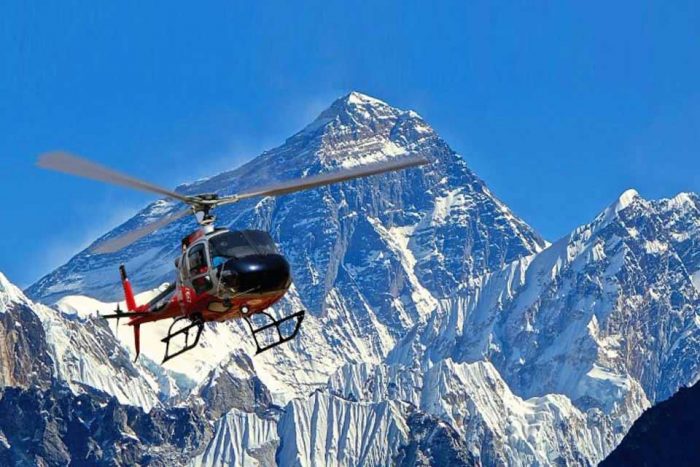
A helicopter in front of Everest. Photo: Nepal Private Tours
Next attempt
As for Tyler Andrews, he still wants to summit Everest faster than anyone else, starting tomorrow. Asked about the style, he says: “Always ascent and return trip; and about using gas or no gas, it is yet to be decided.”